Running a business often involves proving you are following the rules. If you want to expand overseas or open a foreign bank account, you might need a specific document. This document acts like a health check for your business. It confirms that your company exists and follows the law.
In this post, we will explore what a Certificate of Good Standing is and why it matters for your UK limited company.
What Is a Certificate of Good Standing?
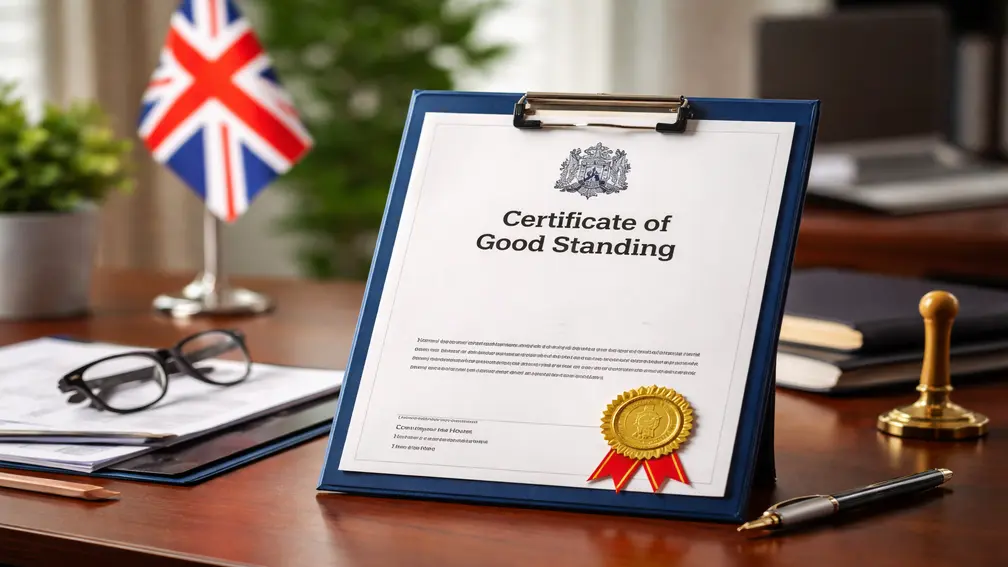
Simply put, a Certificate of Good Standing is a document that you receive from Companies House. The Certificate of Good Standing acknowledges that your company is in ‘good standing’.
‘Good standing’ means that your company is reputable and has no open discrepancies, such as a missing Confirmation Statement. It is an official document which shows that your company is fully operational, compliant with UK Company Law, has paid all necessary fees and is legitimate.
Which Authority Issues a Certificate of Good Standing in the UK?
In the United Kingdom, the only body that can issue this important paperwork is the registrar of companies at Companies House. They hold the official records for every UK limited company. Because they maintain the public register, they are the only ones who can confirm your business status officially. Private agents can help you order one, but the actual certificate always comes directly from the government source to ensure it is authentic and valid.
What Information Is Included in a UK Certificate of Good Standing?
A Certificate of Good Standing contains the following information about a company:
Directors’ names and other details, such as dates of birth and nationalities: This section lists the people currently running the business. It confirms there is at least one natural director in charge. This transparency helps foreign authorities trust who they are dealing with. It ensures that the leadership structure is clear and recorded properly on the public register.
- Company secretaries’ names (if applicable): While not every private company needs a secretary today, if you have appointed one, their details appear here. This adds another layer of verification for anyone checking your company’s structure. It shows that your internal administration roles are filled and officially recognised by the registrar.
- Registered office address: This proves your business has a physical location in the UK where official mail is delivered. It confirms you are not just a name on a piece of paper but have a real presence. This address must match the one held on the public record at Companies House.
- Date of incorporation: This date shows when your company first started its legal life. It proves your unbroken existence since its incorporation. Knowing how long a company has been around can build trust with new partners. It confirms the exact moment your business became a separate legal entity.
- Verification that the company is up to date with its statutory filing requirements: This is perhaps the most crucial part. It confirms you have filed your confirmation statement and annual accounts on time. It shows you respect the rules and are currently compliant with UK regulations. This signals reliability to anyone looking to do business with you.
- Company’s objects (if applicable): Some companies have specific rules about what they can and cannot do as a business. If your articles of association include these restrictions, they may be listed here. This lets third parties know exactly what kind of business activities you are legally allowed to perform.
- Summary statement (previously known as the good standing statement): This is the core message of the document. It explicitly states that no action is currently being taken to strike the company off the register. It serves as the official seal of approval that your company is active, valid, and safe to do business with right now.
What a Certificate of Good Standing Does Not Prove?
While this certificate is powerful, it does not prove everything about a business. It focuses on administrative compliance rather than commercial success. It confirms you have followed the rules of the Companies Act 2006, but it is not a financial report. Understanding its limitations is just as important as knowing its benefits. You need to know exactly what this document can and cannot vouch for before you use it abroad.
- Financial Health or Solvency of the Company: This document does not tell anyone if your business is making a profit or losing money. A company can be in ‘good standing’ regarding paperwork while having zero money in the bank. It simply confirms you filed your accounts, not that those accounts look good. It is possible for a struggling business to still be compliant with Companies House. Therefore, it is not a credit score or a rating of financial stability.
- Absence of Debts, Liabilities, or Legal Disputes: Similarly, this certificate does not guarantee you are debt-free. You might owe money to suppliers or have a loan, and still get a certificate. It also does not reveal if you are being sued in a civil court for a contract dispute. As long as you haven’t broken company law rules that would cause the registrar to remove you, you are technically in good standing, regardless of private debts.
- Director or Shareholder Background Checks: The certificate lists names, but it does not vet the people behind them. It does not prove that directors have a clean criminal record or good personal credit. It only confirms that they are currently listed as officers on the register. If a partner wants to know about the moral character or history of the people running the business, they will need to run separate, specific background checks on those individuals.

Why Do You Need a Certificate of Good Standing?
Most businesses operate locally without ever needing this document. However, once you start looking beyond the UK borders, things change. You usually need this certificate when a third party wants official proof that your company is real and follows the rules. It acts as a bridge of trust between different legal systems. Without it, foreign entities might not recognise your company as a legal structure they can work with safely.
Trading Overseas
When you want to sell goods or open an office in another country, foreign authorities need to know you exist. They cannot easily check the UK register themselves. A Certificate of Good Standing acts as your passport for business. It proves to foreign customs or trade bureaus that your UK limited company is a valid entity. This is often the first step to getting a license to trade abroad.
Financial transactions and investment
Banks in other countries have strict rules about who they lend money to. If you want to open a foreign business bank account or get a loan abroad, the bank will ask for this. They need assurance that your company is not about to be dissolved. It gives investors confidence that they are putting money into a company that has an unbroken existence since its incorporation and is legally sound.
Government contracts and regulatory compliance
Winning work with foreign governments often requires piles of paperwork. They have to be sure they are hiring a legitimate business. A certificate of good standing is often a mandatory part of the tender process. It satisfies their compliance teams that you are up to date with your home country’s laws. It shows you are responsible and adhere to the Companies Act, making you a safer bet for public contracts.
Building trust with clients and business partners
Sometimes, a new partner just wants peace of mind. If you are signing a big deal with a company overseas, they might ask for this certificate. It is an easy way to show you are transparent and reliable. It proves you have nothing to hide from the registrar. Providing this official document quickly can smooth out negotiations and help you close deals faster by establishing credibility upfront.
Who Commonly Requests a Certificate of Good Standing?
The request usually comes from someone who needs to verify your legal status but cannot check Companies House directly. This is almost always an entity outside of the UK. They rely on this official document to perform their due diligence. Whether it is for legal, financial, or regulatory reasons, these bodies need a standardised way to confirm that your company is compliant with UK company law and is not being shut down.
- Foreign Governments and Regulatory Authorities: If you try to register a branch of your company in places like France or the USA, their government needs proof. The local registrar in that country will ask for this certificate. They need to know your UK company is valid before they let you operate on their soil. It ensures that only legitimate foreign companies enter their market. It is a standard requirement for international expansion and compliance.
- International Banks and Financial Institutions: Opening a bank account in a foreign currency is rarely simple. The bank needs to follow “Know Your Customer” (KYC) rules. They will ask for a certificate of good standing to verify your identity. It confirms that the company is active and that the directors listed are the real people in charge. Without it, they cannot legally open the account for you, as the risk would be too high.
- Overseas Business Partners and Investors: When someone invests in your business, they are taking a risk. Investors from other countries want to minimise that risk. They will request this certificate to ensure the company is not in danger of being struck off. It proves that the business they are buying into has been managed correctly regarding statutory filings. It is a basic level of assurance that the legal foundation of the company is solid.
- Legal and Corporate Service Providers: Lawyers and accountants in other countries often need this document too. If you hire a lawyer abroad to handle a property deal or a merger, they need to verify your company first. They have a professional duty to check who their client is. The certificate provides them with the official details they need to draft contracts and represent you legally in their local jurisdiction.
How Long Is a UK Certificate of Good Standing Valid?
Technically, the certificate does not have an expiry date printed on it. However, it only reflects the company’s status on the day it was issued. Because a company’s situation can change quickly, most organisations will only accept a certificate that is less than three months old. After that period, the information is considered too old to be reliable. You will likely need to order a fresh one for new transactions.
Why Foreign Authorities Require Recently Issued Certificates?
Things can change fast in the business world. A company could be in good standing today and fail to file a document next week. Foreign authorities know this. They demand a recent certificate to ensure the information is current. If you present a document that is a year old, you might have been struck off in the meantime. A recent issue date reduces the risk that they are dealing with a defunct company.

Using a Certificate of Good Standing Outside the UK
Since this is a UK document, it is not automatically accepted in other countries. You cannot just hand over the paper and expect it to work in Spain or China. To make it valid abroad, you usually have to go through a process called legalisation. This verifies the signature of the Companies House official. Without this extra step, foreign officials may reject your document as they cannot verify it themselves.
Apostille Requirements for International Use
For most countries, you will need an apostille. This is a special stamp or sticker added to the document by the UK government. It confirms that the signature on the certificate is genuine. It is used between countries that signed the Hague Convention. Once the apostille is attached, the document is legally recognised in all those member countries. It saves you from having to prove the document’s validity repeatedly.
Legalisation and Embassy Attestation
If you are doing business in a country that is not part of the Hague Convention, like the UAE or China, an apostille isn’t enough. You will need further legalisation. This often means taking the apostilled document to that country’s embassy in London. They will add their own stamp. This chain of stamps proves to the final recipient that the document is real, valid, and trustworthy.
Countries That Commonly Request UK Certificates of Good Standing
Many nations frequently ask for this document from UK firms. Countries in the European Union, like Germany and France, often require it for branch registration. In the Middle East, the UAE and Qatar ask for it for nearly all business setups. The USA also requests it frequently. Essentially, any nation with a formal legal system will likely ask for this proof before allowing a foreign entity to conduct significant business
How to Request a Certificate of Good Standing?
Getting this document is a straightforward process, provided your company is compliant. You generally have two main routes. You can go directly to the source, or you can use a professional service to handle it for you. The right choice depends on whether you need extra services like apostilles or expedited delivery. Both methods will result in a valid document, but using a service can save you time and hassle.
Request a Certificate of Good Standing From Companies House
You can order a certificate directly from the Companies House Service online. You will need to log in to your company account. It is cheaper this way, but they send the certificate by standard post, which can take time. Also, they do not offer an apostille service directly. If you need the document for use abroad, you will still have to send it to the Foreign Office yourself afterwards.
Request a Certificate of Good Standing From Legalisation4you
Using a service like Legalisation4you can be much faster and easier. We handle the request and can also bundle the apostille service for you. This means you don’t have to deal with multiple government departments. We ensure the document is correct and get it legalised in one go. This is ideal if you are in a rush or unfamiliar with the complex process of international document legalisation.
Eligibility Requirements to Receive a Certificate of Good Standing
Not every company can just order this certificate. The registrar will only issue it if your company meets strict criteria. If you have missed deadlines or have errors in your records, your request will be rejected. The system checks your status automatically. Before you pay for a certificate, you must be certain that your company records are spotless. Here are the specific requirements you must meet to be eligible.
1. At least one director must be a natural person
Your company must have at least one human being listed as a director. While other companies can be directors, the law requires at least one actual person to be responsible. This ensures there is someone accountable for the company’s actions. If your board is made up entirely of other corporate bodies, you are not compliant with the Companies Act 2006. You must appoint a human director before you can get the certificate.
2. No outstanding filings or overdue statutory documents
You cannot have any “homework” missing. The registrar checks if every required document has been received. If you are even one day late with a form, you are not in good standing. This strict rule ensures that the public register is up to date. It forces companies to be diligent with their paperwork. You must clear any backlog of filings before the system will allow a certificate to be issued.
- Submitting annual accounts on time: Your annual accounts tell the story of your financial year. They must be filed by your specific deadline every year. If these are overdue, your company is immediately flagged. Late accounts are a major warning sign to the registrar. You cannot get a certificate of good standing if your accounts are late. You must file them and wait for them to be accepted before requesting the document.
- Filing an up-to-date confirmation statement (formerly known as an annual return): Every year, you must confirm that the details Companies House holds about you are correct. This is done via the confirmation statement. Even if nothing has changed, you still have to file it to say so. Missing this deadline is a common reason for being denied a certificate. It is a simple form, but forgetting it blocks your good standing status immediately. It proves your company is still active.
- Ensuring that any required changes to company details (e.g., registered office address, director appointments, or shareholdings) have been properly reported: If you move office or appoint a new director, you must tell Companies House. If the registrar believes your information is incorrect, they can challenge your status. For example, if mail to your registered office is returned, you are not in good standing. All your records must match reality. Keeping these details current is a continuous duty. Discrepancies here will prevent the certificate from being issued.
3. No overdue penalties or unpaid fees
If you filed your accounts late in the past, you likely received a fine. You must pay this penalty before you can be considered in good standing. The same applies to any filing fees. You cannot owe money to Companies House. Having an unpaid debt to the registrar is a black mark against your company. You must clear the balance completely to restore your status and get the certificate.
4. No ongoing actions to dissolve the company
Your company must be safe from closure. If you have applied to close the company, or if Companies House has started the process to strike you off, you cannot get a certificate. The document is meant to prove you are active and continuing. If there is a notice in the Gazette saying you are being removed, you are not in good standing. You must halt any strike-off action first.
5. Compliance with director statutory duties
Directors have legal responsibilities they must uphold. While Companies House doesn’t police every decision, serious breaches can lead to disqualification. If a director is banned, they cannot manage the company. The company must show that its leadership is acting lawfully. This broad requirement ensures that the business is being run by fit and proper people. It is about maintaining the integrity of the corporate structure.
- Acting in the best interests of the company and its shareholders: This is a core duty for any director. You must make decisions that help the company succeed. If there is evidence of mismanagement or acting for personal gain, it can lead to legal trouble. While this is harder for the registrar to check automatically, serious violations recorded legally can impact the company’s status. It is about the ethical foundation of how the business is run day-to-day.
- Keeping accurate financial records: You must keep good records of what you spend and earn. This is not just for tax; it is a legal requirement. If you fail to keep accounting records, you are breaking the law. This failure can lead to your company being struck off. Good standing assumes you are maintaining these records properly in the background. Without them, you cannot file accurate accounts, which leads to compliance failure.
- Ensuring that the company meets its tax and regulatory obligations: While Companies House handles company law, you must also respect other laws. Ignoring tax rules can eventually lead to your company being shut down. If HMRC petitions to wind up your company due to unpaid tax, you lose your good standing. Compliance is holistic. You cannot be a “good” company if you are ignoring major regulatory duties elsewhere. It all feeds back into your official status.
- Avoiding fraudulent or wrongful trading: Your company must be operating legally. If there is any investigation into fraud or wrongful trading, your status is at risk. Wrongful trading involves carrying on business when you know you can’t pay debts. This is a serious offence. A company under such a cloud cannot be certified as being in good standing. The certificate implies honest business conduct, so any hint of fraud invalidates that trust.
6. The company must have existed continuously since incorporation
This sounds simple, but it is vital. Your company must have been on the register without a break. If you were struck off and then restored to the register later, this might be noted. However, the key is that you are currently active and have a valid history. It confirms the timeline of your business life. It shows stability and persistence in the business world.
Keep Your Business Compliant and in Good Standing
Maintaining your status is an ongoing job. It is not just about getting a certificate once; it is about good habits. Always file your confirmation statement on time. Pay your fees and update your address if you move. By staying on top of these simple admin tasks, you ensure your business is always ready for opportunities. A company in good standing is a company ready to grow.
FAQ
How Do I Get My Certificate of Good Standing Apostilled?
You can bundle packages and request to have your Certificate of Good Standing certified by a solicitor and then sent to the Foreign, Commonwealth & Development Office (FCDO) to be apostilled.
We will then return a scan of your apostilled Certificate of Good Standing and the original will follow in the post.
Is a Certificate of Good Standing a legal requirement for UK companies?
No, UK companies are not legally required to hold a Certificate of Good Standing. It is typically requested only in specific circumstances, such as international trade or proof of compliance for third parties. However, maintaining good standing with Companies House is always essential to avoid penalties and protect your business reputation.
Can a dormant UK company obtain a Certificate of Good Standing?
Yes, a dormant company can definitely get this certificate. Even if you are not trading, you must still file dormant accounts and confirmation statements. As long as you have met these filing duties and have at least one director, you are compliant. The certificate will confirm your status, just like it would for a trading company. It proves the dormant company is properly maintained and legally valid.
Is a Certificate of Good Standing required for UK branch registration overseas?
Yes, this is one of the most common reasons to need one. If you want to open a branch office in another country, that country’s registry needs proof. They need to confirm your UK company is real before they let you register a branch. The certificate provides the official verification they require. Without it, your application to register a foreign branch will almost certainly be rejected.
How quickly can a UK Certificate of Good Standing be apostilled for international use?
The timing depends on the service you choose. If you use the standard government service, it can take a few weeks. However, using a specialised legalisation service can speed this up significantly. We can often get documents apostilled in just a few working days. Expedited services exist for urgent deadlines. Always factor in shipping times if you need the physical document sent to another country.
Do foreign banks accept digital or scanned Certificates of Good Standing from the UK?
Usually, foreign banks are very strict and want the original paper document. While some might accept a digital scan initially to start the process, they often require the physical copy later. If the document needs an apostille, they will definitely need to see the physical stamp or sticker. Always check with the specific bank first, but be prepared to send the hard copy via courier to avoid delays.
What happens if a UK company loses its good standing after the certificate is issued?
The certificate is just a snapshot in time. If you lose your good standing the next day, the certificate becomes misleading. However, it remains valid on paper for its typical three-month acceptance window. If a partner checks the register and sees you are no longer compliant, the certificate won’t help you. It is crucial to maintain your status continuously, not just for the day you order the document.