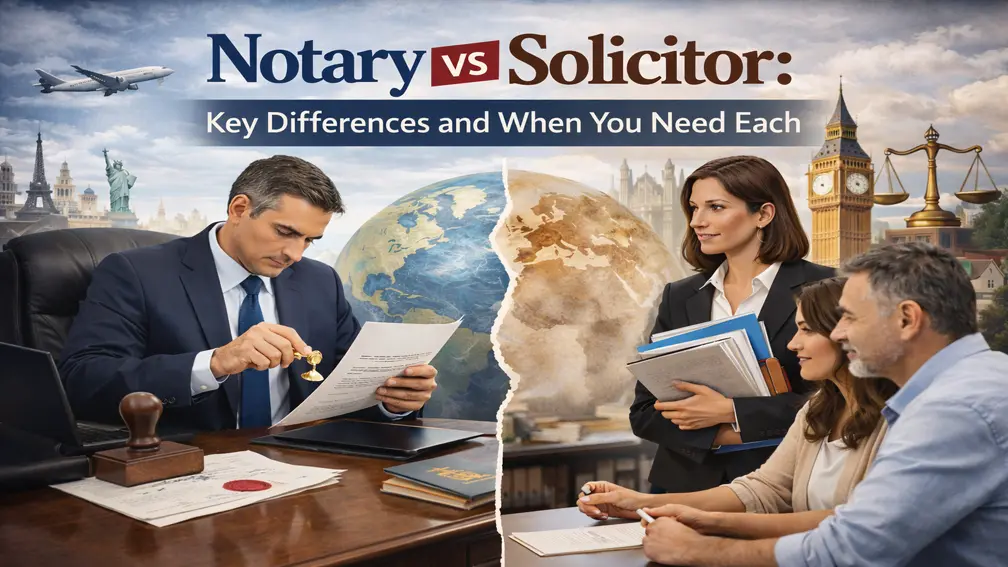
Understanding the different legal roles in the UK can be tricky, especially if you only know that both notaries and solicitors deal with signatures and documents for use both in England and Wales and overseas. The notary vs solicitor question comes up often. Using the wrong professional can mean wasted time, extra costs, and rejected papers. If you need to manage property, settle a family matter, or prepare legal documents for use abroad, getting clear on this topic helps you avoid problems.
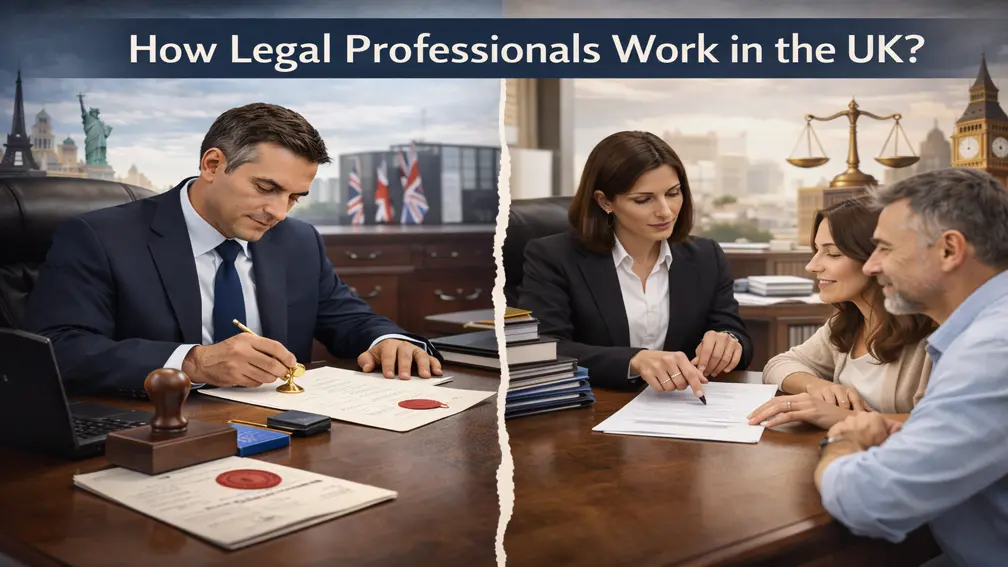
How Legal Professionals Work in the UK?
The legal profession in England and Wales has a structure shaped over many years. Both notaries and solicitors are qualified lawyers, but they work differently. A solicitor is a legal professional you might see helping with wills, business law, or family disputes. Notaries, on the other hand, have a key role in the authentication and certification of documents for use outside of the UK. Both are important, but their training and daily work do not completely overlap.
Why People Often Confuse Notaries and Solicitors?
Notaries and solicitors might seem like very similar professionals. In fact, many notaries are also solicitors, and both can work at the same law firm. Both must follow strict rules and often need to witness signatures, manage confidential information, and explain legal matters to clients. The confusion mainly happens because people are not always told who is needed for which job. The main difference between a solicitor and a notary boils down to whether your documents are for UK or international use.
What is a Notary Public in the UK?
A notary public is an independent professional and a type of lawyer, but not the same as a solicitor. The notary’s key task is to notarise documents. That means adding a notary’s seal and signature, creating documents that are trusted in other countries. Notaries in England and Wales are appointed by the Master of the Faculties. They check the identity of people signing, make sure signers understand what they are doing, and confirm the details are correct. Notaries are also required to keep records of all their notarial acts and are regulated by a different office from solicitors.
Types of Documents a Notary Public Handles
When you need a document to be used abroad, you typically need notary public services. A notary deals with matters that go beyond the UK. They provide notary services, which often involve verifying your ID, certifying the papers, and applying a seal that gives the document legal effect in another country. The services of a notary public are necessary in many different situations and are widely recognised outside of the UK.
Notaries deal with:
- Certifying passports, driving licences, or any other UK private documents for international use: If a foreign bank, university, or employer asks for a copy of your identification and they want to be sure it is real, a notary will check the original and attach a certificate stating it matches, then notarise it for use abroad.
- Witnessing Powers of Attorney or Statutory Declarations for use abroad: When appointing someone to act on your behalf in another country, a notary must witness signatures so the document meets foreign legal standards. Without the notary’s sign-off, the foreign lawyer or official may refuse the paperwork.
- Certifying academic qualifications for overseas employment or study: If you plan to work or continue education outside the UK, a notary confirms that your school or university certificates are genuine, giving foreign employers or authorities confidence in your credentials.
- Authenticating any type of business documents for international transactions: For companies trading abroad or setting up offices overseas, notaries authenticate documents proving company structure or director authority, letting foreign firms or banks trust that their new business partner is legitimate.
When a Notary Is Legally Required?
You will need a notary when an authority overseas asks for notarised documents. This could be for working abroad, buying property, dealing with foreign courts, or opening bank accounts overseas. A notary’s seal and signature have special legal force in many countries. Local standards in England and Wales may accept a solicitor, but abroad, it is often a legal requirement to use a notary public rather than a solicitor.
International Use of Notarised Documents
A document that needs to travel needs extra checks. Once a notary confirms details and affixes their seal, many destinations require further steps. An apostille may be needed from the UK government to confirm the notary’s own qualification and signature. Some countries will require documents to be taken to their embassy for further verification. This all ensures documents from England and Wales are trusted in places like Spain, India, or America.
What is a Solicitor in the UK?
A solicitor is a recognised legal advisor and representative in England and Wales. Their daily work covers a very wide range of legal services, from business law to personal disputes. A solicitor is a type of lawyer who supports clients in legal matters within the UK, taking cases to court, preparing contracts, and offering advice. The profession is regulated by the Solicitors Regulation Authority (SRA), and its focus stays mostly on helping with legal needs that don’t leave the UK.
Areas of Law Solicitors Commonly Practise
Solicitors work across all sorts of legal areas. Some focus on one area, like property law, while others work more generally. Understanding the main types of work solicitors do helps you pick the right one for your particular issue. Legal services include negotiation, drafting paperwork, and speaking up for clients in disputes. Each area of law comes with its own rules and documentation.
- Conveyancing (buying/selling property): Buying or selling a home in the UK requires the help of a conveyancing solicitor. They check all titles and handle the legal documents needed to ensure ownership changes correctly. They help manage payments, finalise all contracts, and file everything with the Land Registry to protect your rights.
- Wills and probate: Writing a will or dealing with a relative’s estate? Solicitors in this area help ensure your wishes are carried out after you’re gone. They will deal with tax issues, apply for probate, and manage the distribution of assets to the people named in your will, or according to the law if there is no will.
- Family law (divorce, custody): Family solicitors work on legal matters related to relationships and children. They guide people through divorce, sorting out financial arrangements, and creating custody agreements. Their work is sensitive but vital, helping families stick to the law and avoid long, drawn-out court disputes where possible.
- Criminal law: When someone is accused of a crime, criminal law solicitors support them through questioning at the police station, court appearances, and evidence gathering. They prepare a defence, advise on possible outcomes, and make sure the client’s rights are fully protected through each step in the process.
- Business law and contracts: Solicitors in business law create and check contracts, provide advice on setting up companies, and help companies follow UK regulations. They work closely with their clients to solve disputes, make sure staff contracts are legal, and reduce legal risks for the business, whether it’s a start-up or an established firm.
Solicitors and Legal Advice in the UK
Solicitors are the main professionals to consult about the law in the UK. They are trained to give direct legal advice about a person’s rights and obligations. When reviewing a contract, starting a business, or facing a dispute, a solicitor guides the client through the rules and helps plan the next move. By contrast, a notary does not usually advise on the content of documents; they focus on verifying and certifying the paperwork for use worldwide.

When Would you Need a Notary Public instead of a Solicitor?
If the main aim is to use a document outside the UK, whether for work, study, marriage, or a property deal, you almost always need a notary public. A solicitor and a notary can both check documents, but outside the UK, the notary’s role carries special legal weight. Foreign offices, banks, and courts usually need documents confirmed by a notary. Using the wrong person can delay everything or cause your documents to be refused outright.
Notary vs Solicitor: Which One Do You Need?
Your choice depends mostly on where your document will be used and what for. For any legal matters within the UK, like settling a contract dispute or buying a home in Manchester, choose a solicitor. If your document is crossing borders, for instance, to Spain or the USA, you need a notary. If you aren’t sure, ask the body that will receive your document or check their published requirements.
- For UK-Based Legal Matters: Legal issues that stay inside England and Wales are usually for solicitors. This covers family problems, local business contracts, buying UK property, and so on. A solicitor can also advise you on your options and represent you before UK authorities.
- For Overseas or International Documents: Whenever a document is required abroad (property sales, powers of attorney, or business deals), get it notarised by a notary public. Foreign officials and organisations will expect to see the notary’s seal and signature for any documents being used in their country.
- For Business and Corporate Use: Businesses often run into both kinds of work: hiring local staff in London (use a solicitor), or opening a bank account in Dubai (need a notary). Notaries handle the authentication of company records, directorship certificates, and board minutes for use in international trading.
- For Personal and Family Documents: Adopting a child overseas or settling a foreign estate? A notary public must check and witness your signature on documents intended for use abroad. If you need to make a will for property in England and Wales, then see a solicitor.
Common Documents: Notary or Solicitor?
Different documents have different requirements. The key is checking where the document is going and what for. You could spend money on a solicitor for a specific document, only to find a notary was needed, or vice versa. Here is an outline of who can help with common documents.
- Powers of Attorney: Lasting Powers of Attorney for the UK are usually prepared by and witnessed by a solicitor. If it is for a transaction in another country, a notary public must notarise the document for it to be valid overseas.
- Statutory Declarations and Affidavits: For legal matters in the UK, solicitors are commissioners for oaths and can handle affidavits and statutory declarations. If the statement is required by a foreign government or court, a notary must prepare or witness the document for it to be accepted.
- Certified Copies of Documents: Certified copies used within the UK can be provided by solicitors. But, for use in a foreign country (like applying for a university or job abroad), a notary public must certify the copy.
- Property and Land Registry Documents: A solicitor manages property deals in England and Wales. If buying property outside the UK, like in Portugal, any documents you need to sign in the UK for use abroad must go through a notary public.
- Company and Commercial Documents: Updating official records or contracts for a UK-based company calls for a solicitor. If your UK company is signing a contract with a foreign company, most countries want the documents notarised by a notary public or a solicitor who specialises in international company law.
Apostille and Legalisation: Where Notaries and Solicitors Fit In
When a notary has verified and sealed your document, many countries will want further confirmation, called an apostille. This authentication and certification step confirms that the notary is properly registered and the signature is genuine. A solicitor can rarely submit documents for an apostille, as most foreign authorities ask for notarisation. The notary is the first step for documents that need legalisation.
The Role of a Notary in the Legalisation Process
A notary must check the original documents, verify signers, and record notarial acts. Once this is done, they apply their seal and signature, enabling the next step—an apostille by the Foreign, Commonwealth & Development Office. This attached certificate then lets the document be accepted abroad. Notaries are also responsible for explaining costs and steps before the process starts.
Can a Solicitor Replace a Notary for Apostilles?
Solicitors can sometimes arrange for an apostille if allowed by the Foreign Office, but this is rare when the recipient is overseas. Most foreign authorities specifically require the notary’s involvement. Documents presented with only a solicitor’s signature risk being refused. Using a notary public or a solicitor with recognised notary services is the best option.
Hague Convention vs Non-Hague Countries
Countries that are part of the Hague Apostille Convention (for example, Spain or France) need just an apostille after the notary has signed. Non-Hague countries, such as the UAE or China, may require even more checks. This could mean extra legalisation at the foreign country’s embassy in London. As a result, always check ahead so you do not miss additional steps.

Notary and Solicitor Costs in the UK
Fees differ between the two professions. Solicitors charge by the hour or may set a fixed fee for a task like conveyancing. Notaries usually charge for each document, and costs can add up quickly—partly due to the level of risk, responsibility, and professional indemnity insurance they carry for documents being accepted overseas.
Solicitor And Notary: Key Differences at a Glance
A side-by-side breakdown can help show how the notary public and the solicitor serve you in different ways. This comparison table may simplify your decision next time you need legal services, either locally or for matters outside of the UK.
| Aspect | Notary Public | Solicitor |
|---|---|---|
| Primary Role | Authenticates, certifies, and notarises documents, mainly for international use | Provides legal advice, represents clients, and handles UK legal matters |
| Main Area of Use | International and cross-border documents | Domestic UK legal issues |
| Legal Authority | Acts as an independent public official | Acts as a legal representative for clients |
| Regulatory Body | Faculty Office of the Archbishop of Canterbury | Solicitors Regulation Authority (SRA) |
| Ability to Give Legal Advice | Limited; advice only related to document execution | Yes; full legal advice within areas of practice |
| Typical Documents Handled | Powers of Attorney, affidavits, statutory declarations, overseas property and business documents | Contracts, conveyancing, wills, litigation, family and business law matters |
| International Recognition | Widely recognised and often required by foreign authorities | Limited recognition outside the UK |
| Involvement in Apostille Process | Commonly required before apostille and legalisation | Usually not sufficient for apostille purposes |
| Client Representation | Does not represent clients in disputes or court | Can represent clients in negotiations and legal proceedings |
| Cost Structure | Fixed or per-document fees | Hourly rates or case-based fees |
| When You Need One | When a document must be used abroad or legally recognised overseas | When you need legal advice or representation within the UK |
| Can Act in Place of the Other? | Cannot replace a solicitor for legal advice or representation | Cannot usually replace a notary for international document use |
Choosing the Right Professional for Your Needs
Choosing between a notary and a solicitor depends on what you need your document for and where it is headed. Be sure to read the instructions from anyone who gave you the paperwork. If you have any doubt, ask clearly. Administrative errors cause delays and extra expense, so spending time checking the requirements always pays off in the end.
Identify the Document’s Purpose
To make the right choice, read your document carefully and see if it needs to be used abroad or in the UK. Look for terms like ‘notarise,’ ‘apostille,’ or names of foreign courts or organisations. Knowing the purpose saves you time and money and avoids the hassle of having to start all over due to a mistake.
- UK use: When your document will be used only in the UK, a solicitor or commissioner for oaths is normally right. They can advise and help with court statements, house transfers, wills, or legal matters for clients in legal matters here. No need for a notary public in these cases.
- International use: For things outside the UK (like working abroad, getting married overseas, or opening a foreign bank account) you need a notary public. Notaries are known globally for helping certify documents for use abroad. Their seals and signatures are accepted by foreign courts and officials.
Check for Combined Services
Some law firms have professionals who are both solicitors and notaries, or you might find two professionals in the same office. This can help when your situation touches both the UK and international legal systems. Be sure you are clear about which hat they are wearing for your case, so you are properly charged and receive the right service for your needs.
Location & Accessibility
Solicitors are widely available across both cities and smaller towns in England and Wales. Notary offices are harder to find, especially outside big cities, as there are fewer notaries in England and Wales. Use the Notaries Society directory or check online for the nearest notary public. Plan ahead because appointments may not be available the next day.
Cost Considerations
Solicitor fees are sometimes more flexible, either a flat fee or hourly. Notary fees are fixed per document in most cases, and can cost more because notaries are carrying out work that involves more risk and professional checks, especially for international law. Confirm all costs before the work starts, and always ask for a clear quote.
FAQ
What are the risks of using a solicitor when a notary is required?
If you choose a solicitor for a job that requires a notary, the most likely result is that your paperwork will be rejected by the foreign official. This can cause delays, lead to lost opportunities or money, and may mean you must start the whole process again, this time with a qualified notary.
Is a notary or a solicitor faster for urgent document processing in the UK?
There are more solicitors than notaries. For urgent legal documents within England and Wales, seeing a solicitor may be quicker. For documents going abroad, if you need to use a notary, get in touch early as appointments may be limited, though notaries are often used to working to tight business deadlines and can sometimes help at short notice.
Can documents be both notarised and drafted by a solicitor?
Yes. It’s common for a solicitor to create a document, then a notary handles the authentication and certification for international use. Some professionals are qualified as both, but to avoid conflicts of interest, your document might be checked by one and notarised by another.
How can I tell which professional a foreign embassy or authority requires?
Instructions with your documents or on official websites will normally state whether you need a notary public or a solicitor. If you’re unsure, ask the embassy or authority directly. Using the wrong professional may lead to your documents being rejected.
Can a solicitor be a notary?
Many notaries are also solicitors. To become a notary, a solicitor must take extra training and be appointed formally. Not everyone with a solicitor’s title can act as a notary. They must be qualified as a notary and hold the authority to provide notarial acts for documents for use abroad.
Do notaries and solicitors need professional indemnity insurance?
Yes. Both notaries and solicitors are required by their regulators to hold professional indemnity insurance. This means if something goes wrong as a result of their advice or service, there is financial protection in place for you, whether you’re using a notary public or a solicitor.