
Arranging a power of attorney for use outside the UK can seem daunting. Legal paperwork and regulations can be overwhelming, but with clear steps, it becomes much more manageable.
This article sets out everything you need to understand about preparing your documents for recognition abroad, including how a UK solicitor or notary is involved, and how the apostille process through the legalisation office works.
What Is a Power of Attorney?
A power of attorney is an official document giving another person the legal authority to manage certain tasks on your behalf. As the “donor” or “grantor”, you choose someone you trust, known as the “attorney”, for this responsibility. The document spells out what powers the attorney has, as well as the time period for which they apply. These powers could involve handling finances, property, or meeting other legal needs if you are unable to do so yourself.
Power of attorney documents are used in many different circumstances, such as if you travel often or face health difficulties. The document, which is sometimes called a letter of authorisation, describes exactly which actions your attorney is permitted to take, and for how long. This structure helps to ensure there is no confusion over who can act on your behalf if you cannot.
Although the main structure is the same across borders, each country has its own template and set of wording requirements for a power of attorney. Occasionally, it needs to be written in two languages or in the language of the country where the document will be used. These differences are necessary for the authorities abroad to recognise and accept your document, so getting it right at the start is important.
In some countries, you may need to provide a passport photo, a photocopy of your passport, or arrange for two witnesses to be present at the time of signing. These differing demands can make the process more complicated.
That is why seeking support from a legal professional in the relevant country is advised. They can draw up the correct wording, check all requirements are met, and provide precise signing instructions. This will help to avoid errors, ensuring your document stands up to scrutiny when needed.
Why You Might Need to Notarise and Apostille a Power of Attorney Document?
When a power of attorney is intended for use in another country, more is required than simply signing it. Normally, the document first needs to be signed in the presence of a solicitor or a notary public in the UK.
The purpose of the notarisation and apostille is to provide assurance. These steps provide verification that your power of attorney is genuine and completed properly. When overseas authorities see that the apostille and notary seals are in place, they can accept the document with confidence. This removes the risk of errors or fraudulent documents being presented. It helps overseas bodies, banks and courts rely on the paperwork you send.
When notarising a power of attorney, the notary will witness the signature. A UK notary public, or solicitor, must see you sign, confirm your understanding, and check no pressure is being applied. This step demonstrates that you have the mental capacity to make such a decision. The notary is there to ensure that your choices are recorded accurately, acting as an important safeguard for all parties.
If you are signing on behalf of a company, the notary will additionally confirm details. If a business is using a power of attorney, the notary must check that the organisation exists, the individual has full authority to sign, and all records match up. The notary checks the company’s background and the details of the person acting to verify everything is in order. This stops unauthorised persons from binding a business by mistake.
Many situations can require both notarisation and an apostille, for example:
- Buying or selling property or a vehicle outside the UK
- Managing assets in cases where you are unable to be present
- Representing a company’s interests abroad
This list is not exhaustive—numerous legal and personal matters might need a notarised and legalised power of attorney. There are general documents which give wide authorisation, and specific or limited documents which cover just one action, ending once completed.
Before it can be apostilled, your document must be checked and signed by a UK notary public or solicitor. The Foreign, Commonwealth & Development Office will only accept papers where a qualified professional has certified the authenticity. Their seal and signature show that the correct checks have been made, and that the document meets international legal standards. This first step is essential.
The Hague Convention in 1961 introduced apostille stamps as a form of legalisation. With this international agreement, the system for verifying documents became more straightforward. Instead of seeking several signatures and stamps, now, one apostille certificate is enough for countries who are part of the Convention. These include over 120 nations. This has made it much quicker and easier to use documents from the UK in other places around the world.
Crucial Details
- Hague Convention Members: It is important to find out if your destination country accepts apostilles. If it does, one stamp is usually sufficient for the document to be accepted abroad.
- Process: The first step is to sign the document with a solicitor or notary. Then, you send it to the appropriate government office, such as the FCDO, to get the apostille certificate attached.
- Non-Hague Countries: If your country is not part of the Convention, a further legalisation step is needed at their embassy or consulate after the apostille has been added.
- Physical Document: Only signed, original documents (never scans) can be apostilled, since authorities need a real ink signature and original seal.
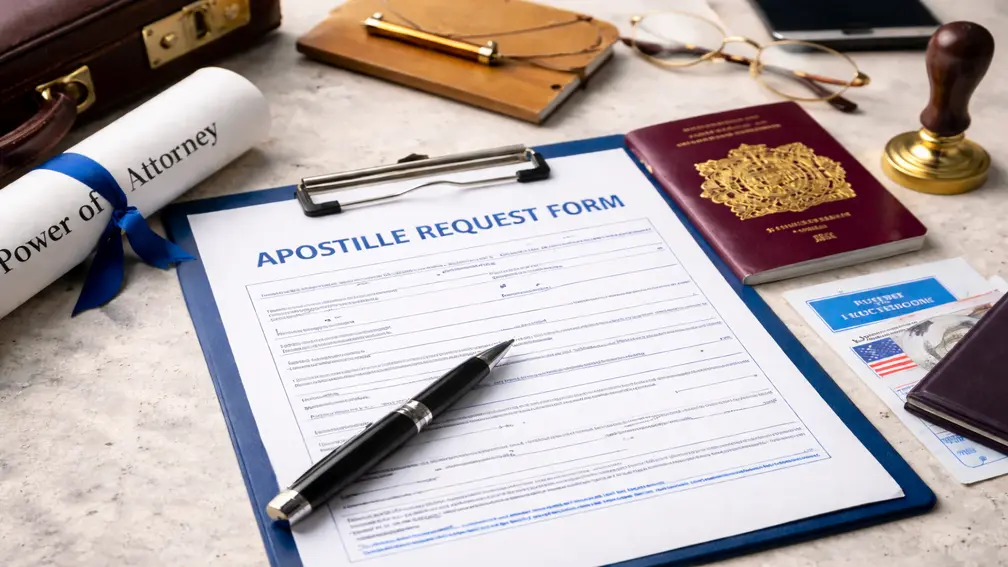
Required Information When Applying For An Apostille Certificate On a Power of Attorney
When applying for an apostille, the authenticity and origin of the document are verified. You need to ensure the signature on your power of attorney matches a recognised solicitor or notary public. The legalisation office will check their records and only issue an apostille if they agree the document is genuine. Always submit the signed original or a properly certified copy.
Below is the required information and documentation needed for the application:
1. The Power of Attorney Document
- Original or Certified Copy: Either the original, ink-signed version or a certified copy (by a solicitor or notary) is required. Plain photocopies are not accepted.
- Notarisation: An authorised notary or solicitor must witness your signature and include their seal and signature, certifying when you signed and confirming your identity.
- No Errors: Make sure the document is complete, with no blank spaces or corrections. Any mark or alteration could result in automatic rejection.
- Notary Details: All identification details (name, seal, and date) must be clear so the office can check the notary’s credentials.
2. Application Form and Information
- Apostille Request Form: All applications need an accurate form linked to your payment and details of your request. These are provided by the FCDO.
- Destination Country: Listing the intended country helps the office prepare and issue the suitable apostille or further instructions.
- Applicant/Contact Details: Correct personal details are needed for any communications. If questions arise, the office must be able to contact you quickly.
- Return Address: Without a reliable return address, your document could be delayed as staff need somewhere to send the completed paperwork.
3. Supporting Documents
- Identification: Sometimes a copy of a government-issued document (passport or driving licence) is needed to match the signer’s details.
- Authorisation Letter: If you are using an agent, a signed letter from you, authorising them to act, must be supplied.
- Translation (If Necessary): Some countries require documents in their native language. A professionally certified translation may be needed in these situations.
4. Fees and Payment
- Payment: Fees must be included with your application, either paid online or by cheque to the Foreign, Commonwealth & Development Office, before your application can be assessed.
- Fee Structure: Charges differ depending on processing speed. Same-day or urgent services cost more than the standard option, and prices are per document.
Key Requirements Checklist
- Original notarised Power of Attorney.
- Completed Application Form.
- Correct payment for fees.
- Valid Destination Country.
- Self-addressed return envelope.
4-Step Process to Notarise and Apostille a Power of Attorney
The FCDO Legalisation Office processes most applications by post or through registered agents. Business and urgent matters may go to a counter appointment. A regular process usually takes a few days, but for speedier handling, premium (same-day) options are available. Legalisation4You supports you every step of the way, managing the details to keep your application on track.
1. Firstly, you will need to email a draft of the power of attorney. Contact us with your initial draft for review before signing. This allows us to identify and correct any problems based on UK requirements. It avoids having to redo the work later if the first document does not meet standards. Reviewing early means we can confirm the document will pass checks the first time.
2. You will need to sign the document in the presence of one of our notaries. Bring your identity documents and proof of address to your appointment for signature. If the power of attorney is for a business, company papers may be needed as well. We will walk you through every step, ensuring that everything is done in line with legal expectations required both in the UK and overseas.
3. After the notarisation, we will submit the document to the FCDO. After the signing is complete, we send all necessary paperwork and arrange processing at the apostille office. We also handle any extra certification needed by embassies if the destination is not a Hague Convention country. Our experience means you avoid the stress of unclear processes or standing in queues.
4. When completed, we will share a PDF scan with you. A digital copy will be sent to you for your records as soon as approval is received. The original can be posted back to your address or sent directly abroad if needed. This saves you time while still letting you share an immediate copy with anyone overseas who needs to see it.
If you intend to use your power of attorney document in another country. Where the destination is not part of the Hague Convention, you will also need further legalisation from their embassy or consulate. Each embassy sets its own requirements and fees, which we can manage on your behalf, ensuring everything matches their expectations.
We help with all parts of the process, from checking a draft to getting the apostille certificate and arranging any further embassy legalisation that is required. Contact us for assistance and advice. We keep the process straightforward, leaving you free to get on with other business.
Notarising and Apostille of a Spanish Power of Attorney
Special requirements apply if the power of attorney is to be used in Spain. The document must usually be in a bilingual English-Spanish format, typically known as the “public form.” Spanish authorities require both languages side-by-side so the notary and their officials can read it clearly, with identical wording in both columns.
Email the draft before finalising. We will check whether the correct information and formatting are in place. If something needs adjustment, either you or your Spanish lawyer can make those changes, saving time and avoiding costly mistakes after the document is signed.
Attaching a certified, signed and stamped copy of your passport is common, and may be compulsory. If you need an NIE number, a certified copy of every page might be necessary. Spain has strict anti-fraud rules, so it is important to follow all these steps to avoid rejection.
Revoking a Power of Attorney
It sometimes becomes necessary to cancel a power of attorney before its expiry date, for example, if your plans change. In these cases, a formal “Deed of Revocation” is required, and this must also be signed in front of a notary public. Similar to issuing the original, your revocation will often need to be legalised and apostilled to be valid abroad.
The deed of revocation will need to be served on the attorney. You must officially notify your attorney of the cancellation. They should receive the revocation in writing so there is evidence you have ended their authority, protecting you from being held responsible for actions after revocation. Keeping good records can be essential for legal reasons.
We would recommend getting a lawyer in the country where the power of attorney is being used. Local legal guidance helps ensure that the deed is recognised by foreign courts. National laws differ, and using a locally-prepared revocation makes sure no unexpected legal obstacle stops your revocation from taking effect.
However, if you need assistance drafting the document in English, we can assist. Our team is able to prepare revocation documents in English if necessary. We can help with notary appointments and with all legalisation processes, making sure everything is accepted abroad as intended.
Notary Requirements for Power of Attorney Apostille in the UK
POA documents to be apostilled in the UK must be signed in front of a practising notary public or solicitor who checks your identity and acts as a witness. The notary applies their official seal, signature and confirmation of their position. Without this, the Foreign, Commonwealth & Development Office will not consider the document valid for apostille.
What the Notary Public Must Verify?
The notary or solicitor must check that you are who you claim to be by comparing your identification with the details on the document. They must satisfy themselves that you have the ability to understand what you are signing and that you are not being forced. These checks make sure your legal instructions are clearly and freely given.
Common Reasons Power of Attorney Apostille Applications Are Rejected
Even a small oversight can mean your application is rejected by the authorities. Common mistakes are missed signatures, old document versions, or notarial details that do not meet legalisation office requirements. It’s important to check these details before submitting documents to avoid having to repeat work or pay fees again.
- Incorrect Signatures or Missing Dates: Every signature and date must be in place. A missing date or a signature that does not match the official identification can cause the document to be declined. Always check your details carefully, and make sure you sign in exactly the same way as your legal documents.
- Improper Notary Stamp or Signature: The notary must apply the correct, registered seal and sign the document legibly. If the seal is unclear or missing, or if their written statement is incomplete, the apostille cannot be issued. It is vital for the notary to complete every required field to prevent delays or rejections.
- Using an Outdated or Invalid Power of Attorney: Law and formatting requirements can change, so you must use a current version. Any damage, editing or signs of alteration on the paperwork could mean refusal. Always use a new and clean template, and check that it is suitable for the country in question before proceeding.
How Long Does It Take to Apostille a Power of Attorney in the UK?
Standard government processing through the FCDO can take 15-20 working days. Private agents can usually offer faster options, completing the process in as little as one to three working days. Electronic apostilles may be available and are faster, but some countries will only accept traditional paper certificates. Always confirm with the destination authority before deciding.
Standard Apostille Processing Times
When posting your documents directly to the government, you should allow for a wait of several weeks, particularly at busy times. Reliability is high, but if you need the document urgently, consider using other options. Delays can occur due to high demand or postal issues, so plan ahead.
Same-Day and Express Apostille Options
Urgent cases can benefit from premium services, arranged by experienced agents. Documents are hand-delivered and processed quickly, often on the same or next working day. These services cost extra, but the speed may be essential for strict deadlines relating to international transactions.
Factors That Can Cause Delays
Delays might be caused by errors in the application, incomplete paperwork, problems with the notary’s details, or high demand at the legalisation office. Professional assistance reduces the risk of such errors, ensuring documents are prepared correctly the first time.
Costs Involved in Apostilling a Power of Attorney
The overall expense includes notary fees, government and agent charges, and sometimes additional consular legalisation. Costs range from £50 to over £200 per document. Make sure to check all fees in advance so you understand the total you might need to pay, especially if your application is time-sensitive or complicated.
Should You Use a Professional Apostille Service for Power of Attorney?
Working with a professional service is a sensible choice for most people. The rules are complex, and errors can be expensive and time-consuming. Experienced services ensure documents are correct, valid, and accepted the first time, helping you to avoid any costly mistakes or unnecessary delays. For urgent transactions or high-value matters, this support is worthwhile.
Risks of Handling Apostille Applications Yourself
If you prepare and send the application yourself, mistakes are easy to make thanks to shifting international requirements. Rejected paperwork can mean losing fees or missing deadlines. Even the simplest errors can lead to a failed application, so the time and risk involved can outweigh the small cost savings of not seeking support.
Benefits of Using a UK Apostille Specialist
A specialist will review all paperwork before submission, arrange fast processing (sometimes just 1-2 days), and manage the application from start to finish, including dealing with any embassy or consulate requirements. Their expertise ensures that your paperwork is securely handled and properly accepted by authorities abroad.
How Legalisation4You Simplifies the Process?
Legalisation4You helps with all parts of the process, from drawing up your draft power of attorney, arranging appointments with solicitors and notaries, to submitting the final documents for apostille and any embassy legalisation. Our team ensures every step is completed with care, so you can trust your documents will be accepted overseas without complications.
FAQ
Is a certified copy of a power of attorney acceptable for apostille?
A certified copy can be apostilled if it has been signed and certified by a UK solicitor or notary public, showing it is a true and accurate copy of the original. Some countries, however, will only accept the original signed power of attorney, so always check the requirements for where you will use the document first to prevent delays.
What happens if the foreign country does not accept apostilles?
Where the destination country is not part of the Hague Convention, you need to get your power of attorney further certified at the relevant embassy or consulate in the UK after the apostille. This added legalisation can take extra time and cost more, but it is essential to gain recognition by foreign authorities.
Can a power of attorney be apostilled if the donor lacks capacity?
No, a power of attorney cannot be legalised and apostilled if the donor does not have the capacity to understand and approve the document. The notary or solicitor must be sure that the person was of sound mind at the time of signing, as otherwise they cannot act as an official witness to the signature.
Do banks and financial institutions abroad require a recently issued apostille on a power of attorney?
Banks and similar bodies in other countries often insist on a power of attorney that has been apostilled within the past 6 to 12 months. This shows them the document’s details are up to date and the authority has not since been withdrawn or altered.
Is a power of attorney apostille still valid if the document is amended or updated later?
If changes are made to your power of attorney after it has been notarised and apostilled, a new round of notarisation and apostille is needed. The old apostille only applies to the original version and becomes invalid if the document changes, so always get the new version certified and legalised anew.
Can multiple powers of attorney be apostilled together in a single application?
Yes, you may submit more than one document at once. However, each power of attorney will need to be separately notarised and must have its own apostille certificate from the legalisation office, and a fee is payable for each.
Can you apostille a Power of Attorney signed outside the UK?
No, if your power of attorney was signed outside the UK, it cannot be apostilled through the UK Foreign, Commonwealth & Development Office. Apostille certification by the UK is only for UK-signed or certified documents. If signed abroad, the correct local legalisation process must be followed instead.