
You might need to use your UK divorce documents in another country. To do this, you must get your document officially recognised. This process adds a specific stamp or certificate to your paperwork. It proves your divorce certificate is real and legally binding. Understanding how to obtain an apostille in the UK saves you time and stress. This guide explains everything about the process, from costs to requirements, ensuring your documents are correctly prepared for overseas use.
What Is an Apostille for a Divorce Certificate in the UK?
An apostille for a UK divorce certificate is an official document. The UK Foreign, Commonwealth and Development Office (FCDO) issues it. This document legalisation allows you to use your papers in foreign countries. It checks the court seal or signature to confirm the document is genuine. Once the apostille certificate is issued, overseas authorities will accept it. You often need this if you plan to remarry abroad or update your legal status.
Why is an Apostille required for a Divorce Certificate?
Usually, the state that created the document provides the apostille certificate. Sometimes, another country can issue an apostille. Adding this certificate confirms the stamps and signatures are real. You can then show it in any nation that follows the Hague Apostille Convention. The foreign authority will accept the document without asking for more proof.
Legalisation simply attaches a paper apostille to a UK public document. It acts as official proof that a signature or seal is genuine. Keep in mind that the FCDO legalisation does not approve the actual information written inside the document.
When Do You Need to Apostille a UK Divorce Certificate?
You must legalise your UK divorce papers when dealing with authorities outside the UK. Common reasons include getting married again in another country. You might also need it to update foreign legal records or apply for a visa. This legalisation service ensures your paperwork is valid. It allows you to use your document safely in Hague convention countries. Without this official check, a foreign government will likely refuse your paperwork.
Types of UK Divorce Documents That Can Be Apostilled
Various UK court documents prove a marriage has ended. The FCDO can legalise these to show their validity abroad. Most of these must be original or official court copies. Often, you will need a solicitor’s certification to confirm a wet-ink signature. Both e-apostille and paper options exist for these official UK documents.
- Decree Absolute: A decree absolute is the final legal document that ends your marriage. It is the most common paper people need to legalise. The FCDO requires the original decree absolute or an official court copy. A certified copy must have a clear court seal. If you have an original decree absolute stamped by the court, it usually passes without issues.
- Decree Nisi: A decree nisi is an earlier court order. It shows the court agrees you can divorce, but it does not officially end the marriage. Some foreign authorities ask to see this document. You can get an apostille for a decree nisi. It goes through the exact same process as the final document.
- Certified Copies from the Court: Sometimes you lose your original papers. You can ask the court for a certified copy. The court staff will stamp and sign this new paper. The UK legalisation office accepts these official copies. However, normal photocopies will fail. You must get the copy directly from the court that handled your case.
- Digital vs Paper Divorce Certificates: Courts now issue many divorce papers digitally. You can print a digital document, but the rules differ. If you print a digital file, you usually need a notary public in the UK or a UK solicitor to certify it first. Paper documents with an ink signature from the court can usually go straight to the FCDO.
Requirements to Apostille a Divorce Certificate in the UK
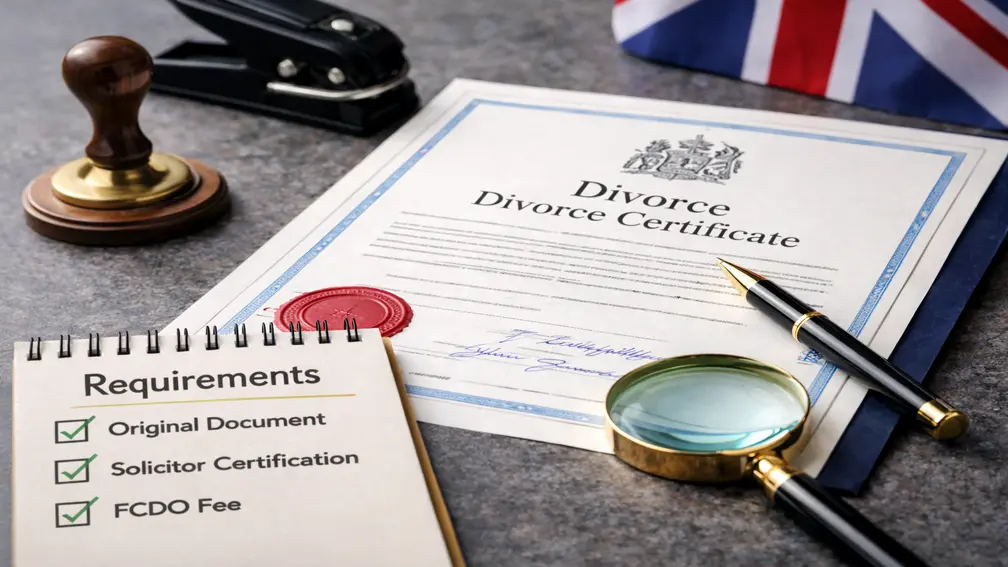
To get your document legally recognised, you must meet specific rules. You send your document to the FCDO legalisation office. They check the ink signature or court seal. The standard fee is £40 per document, plus postage. Passing this check authenticates it for purposes outside of the UK.
Original vs Certified Copy – What Is Accepted?
The FCDO prefers original documents straight from the court. These must show a real signature or a raised seal. Official court copies are also completely fine. However, standard photocopies are strictly rejected. If you only have a photocopy or a digital printout, a solicitor must certify it first.
Who Can Certify a Divorce Certificate?
Only specific people can officially certify these documents. The clerk of the court that granted your divorce is the best option. They will add a raised seal and their signature. For international use, the government then adds the apostille. This confirms the clerk’s authority.
Do You Need a Notary or Solicitor?
Do I really need a lawyer for this? It depends on your paperwork. If you have an original document with a court seal, you do not need a solicitor. If you download a digital decree absolute, things change. You must include solicitor certification. The lawyer confirms the digital copy matches the real electronic record.
Common Mistakes That Lead to Rejection
Many people make simple errors. The biggest mistake is sending a plain photocopy. The FCDO will immediately reject this. Another error is sending a document without a clear court seal. Sometimes, people forget to pay the correct fee. Ensure your documents are correctly prepared before sending them off.
4 Step Process to Apostille a Divorce Certificate
Applying for an apostille does not have to be confusing. The process involves getting the right paper, checking if you need a lawyer, and sending it off. Following these simple steps ensures your documents get approved quickly. This prepares your paperwork for international use under the Hague Convention.
1. Obtain the Correct Divorce Document
First, find the document you need. This is usually your decree absolute. Make sure it is the original or an official copy from the court. Check for a clear, stamped seal or an ink signature. If you cannot find it, contact the court to order a new official copy.
2. Certification (If Required)
Look at your document closely. Is it a digital printout? If so, you need a UK solicitor or notary public to certify it. They will sign it to say it is a true copy. If you have the original paper from the court with a wet-ink stamp, you can skip this step entirely.
3. Submit to the UK Legalisation Office (FCDO)
Next, you submit the document to the government. You send your documents to the FCDO along with the required form. You also need to pay the official fee. Most people send their documents by post. Make sure you use a secure, tracked mailing service to prevent loss.
4. Receive the Apostilled Document
After the FCDO checks your paperwork, they attach the apostille stamp. A physical certificate is added directly to the back of your document. They then mail the document to us or directly back to you. Your document is genuine and ready to be used abroad.
How Long Does It Take to Apostille a Divorce Certificate in the UK?
Waiting for official paperwork can feel stressful. Processing times vary based on how you apply. Generally, the UK service takes between one and fifteen working days. Knowing the timelines helps you plan your plans abroad without unnecessary delays.
Standard Processing Times
The normal FCDO service usually takes about five to fifteen working days. This timeline starts from the day they receive your paperwork. Postal delays can add extra time. It is always best to start this process well before your travel date or deadline.
Express / Same-Day Apostille Options
Do you need your papers quickly? Some registered businesses offer a fast apostille service. They have special access to the legalisation office. This can reduce the wait to just one or two days. You will pay a higher apostille pricing for this speedy option.
Factors That Can Delay the Process
Several issues can slow things down. If your document cannot be legalised because of a missing signature, the FCDO will return it. Unpaid fees or missing contact details also cause major delays. Busy periods at the government office, like summer holidays, can extend the standard waiting times.
Can You Apostille a Digital or Scanned Divorce Certificate?
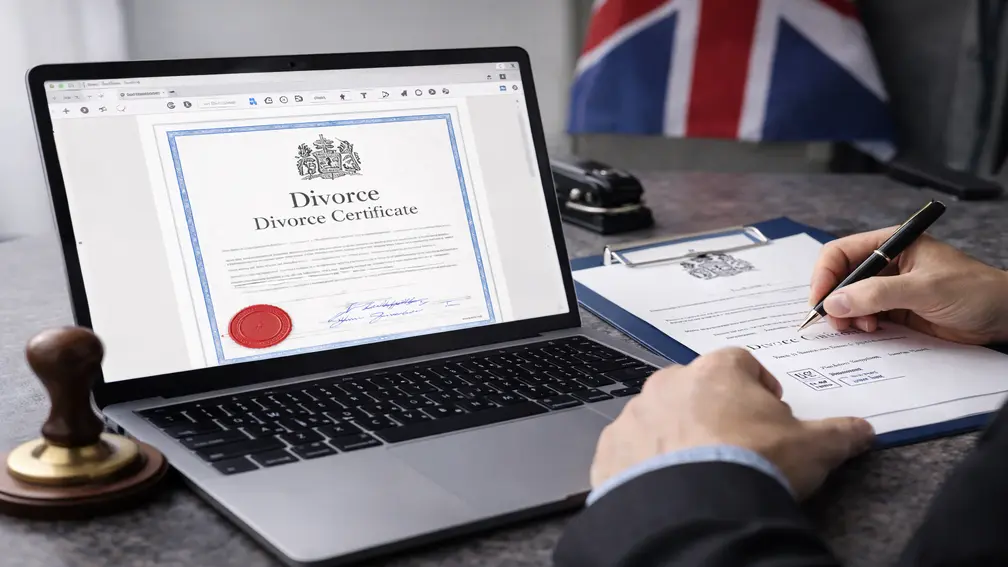
Yes, you can use digital papers. Many courts now send divorce outcomes via email. However, the rules for electronic files are quite strict. A digital file needs extra steps before the government will accept it.
UK Rules on Electronic Documents
The UK allows the legalisation of digital files through the e-apostille system. You upload the PDF directly to the government website. However, the document must contain an advanced electronic signature from the court. If it does not, a solicitor must print and certify the document before you apply.
When a Physical Copy Is Required
Not all foreign countries accept e-apostilles yet. Some governments still demand a traditional paper apostille. Always ask the overseas authority what they prefer. If they want paper, you must print your digital file, get it certified by a UK solicitor, and apply for a physical stamp.
Do You Need Translation After Apostille?
You might wonder if the stamp is enough. Often, you also need to translate your papers. The apostille certification is an international standard, but the text on your decree absolute is in English. Foreign organisations usually need to read the details in their own language.
Countries That Require Certified Translation
Most countries where English is not the main language require a translation. Countries like Spain, Italy, and France will ask for this. You must get the document translated after the apostille certificate is attached. The translator must also certify that their work is accurate.
How Legalisation4you Can Help You Apostille a Divorce Certificate?
Managing official paperwork is difficult. Legalisation4you takes the stress away. We handle everything from checking your papers to dealing with the FCDO. Our service ensures your documents meet all rules so you can move forward with your international plans.
Expert Handling of Your Documents
We review every paper carefully. We check signatures, seals, and dates. If you need a solicitor to sign your digital file, we arrange that too. Our team ensures your document is valid before it ever reaches the government office. This prevents annoying rejections.
Fast and Reliable Apostille Service
We offer a leading apostille service to speed up the process. We submit documents daily. If you are in a rush, we provide quick turnarounds. You can select your apostille service speed based on your needs and budget. We keep you updated at every stage.
End-to-End Support
From your first question to the final delivery, we help you. You simply get in touch and send your papers. We handle the forms, the government fees, and the postage. When the process finishes, we securely post your legalised documents back to your home.
International Expertise
Different countries have different rules. We know exactly what each embassy demands. Whether you need an apostille for divorce in Europe or further away, we guide you. We make sure that foreign organisations so that the document is accepted without any trouble.
FAQ
What is a decree nisi?
A decree nisi is an early court order. It states the court sees no reason why you cannot divorce. It includes the court seal, names, the date, and important notes. The phrase means “rule unless”. It gives a six-week waiting period in case anyone changes their mind before the final order.
What is a decree absolute?
A decree absolute is the final legal document that ends a marriage in the UK. You need it for divorces started before 6 April 2022. You must apply for it; it is not automatic. You apply six weeks and one day after the decree nisi is granted.
Can I apostille a divorce certificate issued outside the UK?
No, the UK FCDO can only legalise UK documents. If your divorce happened in another country, you must get the apostille from that specific country. For example, if you get divorced in France, the French government must issue the stamp. We can only process paperwork originating in the UK.
Can someone else apply for the apostille on my behalf?
Yes, absolutely. A friend, family member, or a reliable apostille agency like Legalisation4you can handle it. We regularly submit paperwork for our clients. You do not need to apply in person. You just arrange apostille services with us, and we do the hard work for you.
What if my divorce certificate is damaged or unclear?
If your document is torn or the writing is faded, the FCDO might reject it. The court seal and signature must be perfectly clear. If your document is damaged, you should order a fresh, certified copy directly from the court before applying for legalisation.
Are there specific countries where an apostille may not be recognised for a UK divorce certificate?
Countries that are not members of the Apostille Convention will not accept it. Over 127 states accept it, but countries like Iran, Malaysia, and Vietnam do not. For these nations, you need extra embassy legalisation. We can help you navigate this complex process.
Why may the FCDO reject divorce certificates for the apostille?
The FCDO rejects documents if they lack a court signature or seal. If the document is rejected, it is often because someone sent a plain photocopy. They also refuse electronic printouts that a UK solicitor or notary has not officially certified.
What is the cost of apostilling a Decree Absolute?
The standard price for getting an apostille for a single document is usually around £100. This typical fee includes the mandatory FCDO government charge and VAT. If you need a faster service or solicitor certification, the final price will be higher.