
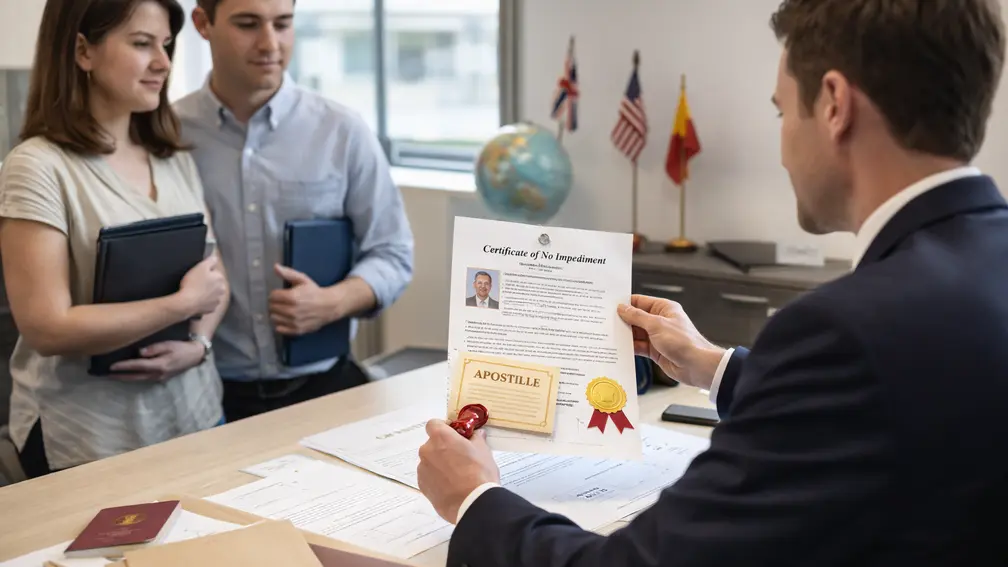
Do you plan to marry overseas? You will likely need to ensure your documents are prepared correctly. A Certificate of No Impediment is often the main document you need to prove you are legally free to marry. To use it outside of the UK, you must go through the legalisation process. This guide explains how to get a certificate of no impediment apostille and make your documents legally valid for use.
What is a Certificate of No Impediment (CNI)?
A certificate of no impediment (CNI) is a crucial legal document that certifies your eligibility for marriage or a civil partnership. It acts as official proof for foreign authorities that you meet all legal requirements. This certificate usually contains essential information about you and your partner. Specifically, it includes details like:
- Your full names and addresses, showing exactly who is applying to marry abroad. This proves your identity to the overseas registrar.
- Dates and places of birth, which authorities match with your birth certificates to confirm you are who you claim to be.
- Current marital statuses, proving neither of you is currently married to someone else, and that you are free to wed.
- Confirmation that there are no legal reasons preventing your upcoming marriage from taking place legally in that foreign jurisdiction.
Who Issues a CNI in the UK?
If you live in the United Kingdom, you must get this document from your local government authority. The local register office is responsible for providing it. You will need to make an appointment with the registrar and give notice of your marriage. After a waiting period, the registry office provides the official UK document. Keep in mind that a document issued here is only for residents.
Countries That Require an Apostilled CNI
Many nations ask for an apostilled CNI before they let you marry. If the destination is a country that is part of the 1961 Hague Convention, they will demand this stamp. The Hague Convention rules state that an apostille is an official certificate that proves a document is real. You must present this to the authorities in the country where the wedding happens.
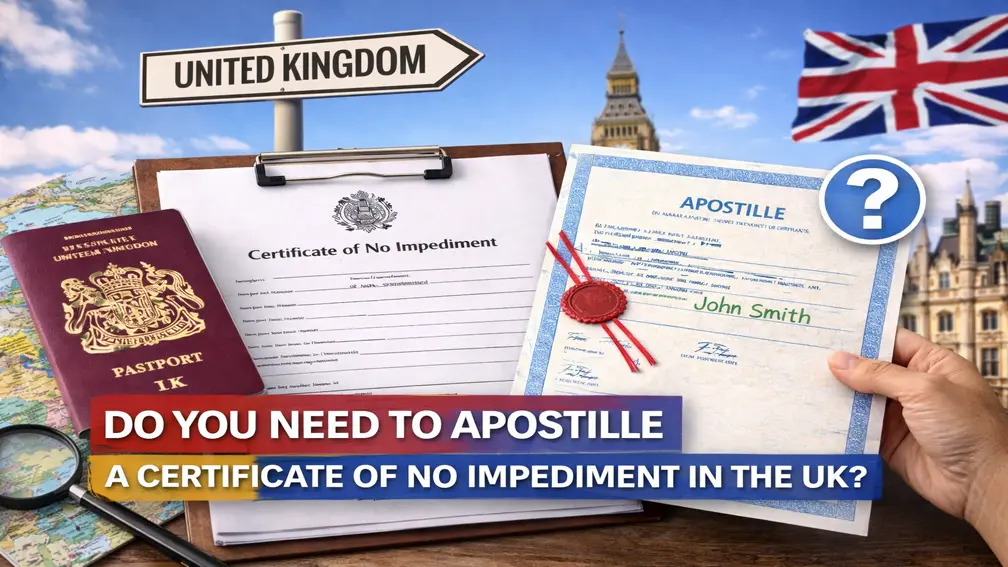
Do You Need to Apostille a Certificate of No Impediment in the UK?
Unfortunately, the answer is: it depends. It depends on where you are getting married. BEST ADVICE – ask the celebrant of the marriage or the person or company helping you organise your wedding. For Certificates of No Impediment, you don’t need notarisation from a notary. The Apostille will go directly on the back of the CNI and is the UK Government confirming that the document is genuine as per the terms of the Hague Apostille Convention.
Situations where an apostille is mandatory
You definitely need an apostille if the foreign government explicitly asks for legalised documents. Without it, the local registry abroad will reject your paperwork. This means you cannot get married abroad. Always check the rules of the specific country. If they are part of the Hague system, document legalisation is a strict legal requirement you simply cannot avoid.
When a translation may also be required
Sometimes an apostille certificate alone is not enough. If the country uses a different language, you might need a certified translation. This translation helps the local officials read the details on your certificate issued in English. Usually, you get the document apostilled first. Then, a professional translator converts the text. Check if the translation itself needs a solicitor certification as well.
Common country-specific requirements
Every nation sets its own rules for foreign weddings. Some places demand that the document be used within three months or it expires. Others require marriage certificates and the CNI to be signed by a UK official before arrival. A few places might even ask for embassy attestation services on top of the FCDO apostille. Always verify these precise details early.
How to Get an Apostille for a Certificate of No Impediment in 5 Steps?
To get an apostille for a Certificate of No Impediment (CNI), obtain the original document from your local registrar, then submit it to your country’s competent authority (e.g., FCDO in the UK, Secretary of State in the US) for legalisation. The process verifies the registrar’s signature to make the document valid for foreign weddings. Follow these basic steps to legalise UK documents smoothly.
1. Obtain Your Certificate of No Impediment
First, book an appointment at your local register office. You must bring proof of identity, like a passport, and proof of address. You give notice of your intention to marry. After waiting about a month, you can collect the physical document. Remember, you need the original document, not a photocopy, because a copy cannot be legalised for this exact purpose.
2. Ensure the CNI Is Correct and Valid
Before you send anything away, check the details carefully. Ensure your names and dates match your passport exactly. The document must be issued and signed by the registrar. If there are any mistakes, you might need to start over. An incorrect document cannot be legalised by the government. Taking five minutes to review it saves you massive headaches later on.
3. Submit the CNI to the UK Legalisation Office (FCDO)
Next, send the paperwork to the UK FCDO. The legalisation office is the only government body that issues the official UK apostille. They will check the signature of the official who signed your certificate. Once they verify the authenticity, they attach the paper apostille to the back. This step is the core of the document legalisation services process.
4. Choose Standard or Premium Apostille Service
You have a couple of choices for speed. The FCDO offers a standard apostille processing route, which takes a bit longer. If you are in a rush, some businesses provide a premium service. This faster option cuts down the turnaround time significantly. Think about your departure date and how much postage time you have left before deciding which service to pick.
5. Receive Your Apostilled CNI
Finally, your certificate of no impediment apostilled arrives in the post. Inspect the attached certificate to make sure the seal is clear. Now you hold a fully legalised UK document. You can pack this safely with your luggage. Present it to the foreign authorities when you arrive, proving that you are legally free to marry your partner overseas.
How Long Does It Take to Apostille a Certificate of No Impediment in the UK?
We strive to provide quick and reliable results, so you can focus on planning your wedding. Typically, a certificate of no-impediment will only need to be apostilled. We can apostille the document on our Premium Service on either the same day or the next day (depending on when we receive the document), or on our Standard Service within 3-5 working days.
Can You Apostille a CNI Online or by Post?
Yes, you can apostille a Certificate of No Impediment (CNI) by ordering the service online and submitting the document by post. → GOV.UK +1. However, a CNI cannot be processed using the electronic e apostille service. It must receive a paper-based apostille applied directly to the original document. Here is the breakdown of the process depending on how you choose to apply.
Applying via the FCDO Legalisation Office
You can post your documents directly to the UK Foreign Office. You pay the fee online, print a cover sheet, and mail it to them. They process it and send it back via courier. This is often the cheapest way, but you manage all the postage and tracking yourself. If the document has issues, they will simply return it unapproved.
Using a Registered Apostille Service Provider
Alternatively, you can hire a UK-based legalisation service like Legalisation4You. You mail your CNI to the agency, and they handle the FCDO legalisation for you. They hand-deliver documents to the office, ensuring a faster turnaround. This service, from start to finish, removes the stress. A professional team checks the paperwork first, ensuring there are no errors before submission.
Pros and Cons of Each Method
Applying directly saves money but requires more patience. The standard postage time can cause anxiety as your wedding date approaches. Using an agency costs a bit more, but the service ensures speed and peace of mind. If you make a mistake on your own, your document issued might be rejected. Agencies catch these mistakes early, saving you precious time.
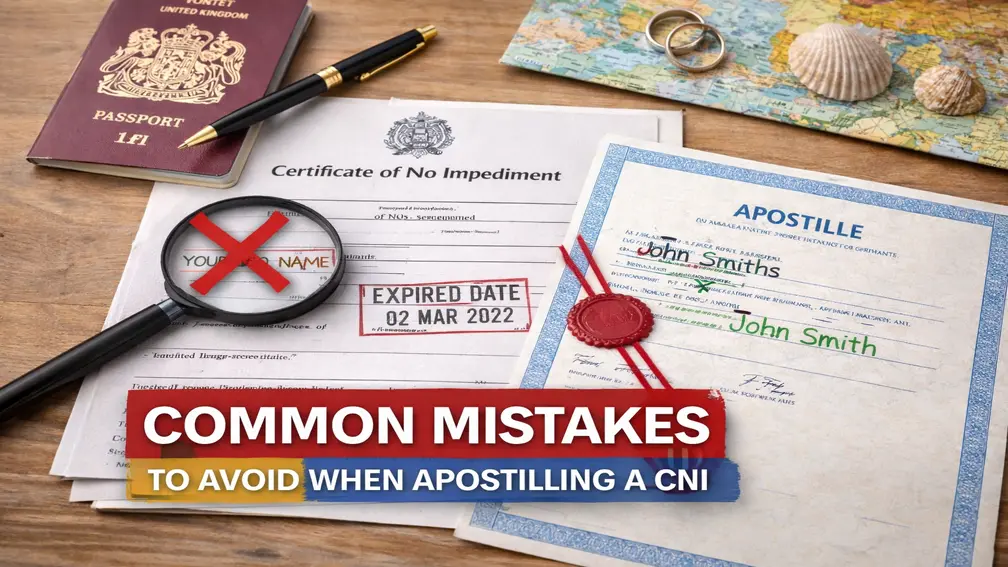
Common Mistakes to Avoid When Apostilling a CNI
Getting your paperwork ready for a wedding abroad is stressful. Naturally, people make mistakes when they rush. To keep your legalisation process moving smoothly, you should watch out for a few frequent errors. Avoiding these pitfalls ensures your documents are processed without delay. Let us look at the most common things that go wrong when people apply for an impediment apostille.
- Submitting incorrect or incomplete documents: Never send a photocopy to the legalisation office. The FCDO only accepts the original document signed by a UK official. If you send copies, the document cannot be legalised. Also, make sure you include the correct return address and payment details. Missing basic information will cause the office to return your file untouched, delaying your entire wedding schedule.
- Using an expired or invalid CNI: Did you know a CNI has a limited lifespan? Most countries will not accept a certificate issued more than three to six months ago. If you start legalising a certificate that is too old, foreign authorities will reject it. Always check how long the document remains valid in your destination country before you pay for an apostille certificate.
- Not checking destination country requirements: Assuming every country has the same rules is a huge mistake. Some nations only need a standard UK apostille. Others demand extra steps. If you guess, you might arrive at the local registry abroad missing vital stamps. Speak to your wedding planner or the local town hall overseas. Finding out exactly what they want saves you from a wedding disaster.
- Ignoring translation or embassy legalisation needs: Do not forget the language barrier. If you marry in a non-English-speaking country, an English CNI might not work. You will likely need a certified translation. Furthermore, if the country is outside the Hague Convention, you will require embassy attestation services too. Ignoring these extra requirements means your document is virtually useless when you finally land abroad.
Do You Need Additional Legalisation After the Apostille?
No, you generally do not need additional legalisation or consular legalisation after a document has been apostilled. The Apostille Convention of 5 October 1961 abolished the need for further authentication, allowing apostilled documents to be directly presented in any country party to the convention. This makes the whole process of getting married abroad much simpler for couples from the UK.
When Embassy Legalisation Is Required?
You only need embassy stamps if the destination country rejected the 1961 Hague Convention rules. In these cases, the UK apostille is just step one. After the FCDO attaches their certificate, the document goes to the specific country’s embassy in London. They add their own official seal. Only then is the paperwork ready to be used by foreign authorities.
Countries Outside the Hague Apostille Convention
Places like the UAE, Qatar, and China follow different rules. Because they are not part of the Hague system, an apostille is an official certificate that means little to them on its own. They demand full consular legalisation. If you plan to marry in one of these countries, prepare for a longer, more expensive process.
Combining Apostille and Consular Legalisation
For non-Hague nations, you must combine both steps. First, you legalise UK documents at the FCDO to prove the UK signature is real. Second, the foreign embassy verifies the FCDO’s apostille. This double-layered approach takes longer. You must factor in the extra working days required by the embassy. A legalisation service can usually manage this complex chain for you.
Why Use a Professional Apostille Service for a CNI in the UK?
Using a professional apostille service for a Certificate of No Impediment (CNI) in the UK ensures your marriage documents are legally recognised abroad, saving time and preventing rejection by foreign authorities. These services offer expertise in navigating the Foreign, Commonwealth & Development Office (FCDO) process, providing faster processing times, notary services, and ensuring the CNI is valid (usually under 3 months old).
- Significant Time Savings: Planning a wedding takes up all your free hours. A dedicated agency speeds up the apostille processing, often getting it done in just a day or two. You avoid dealing with the post office, tracking numbers, and government queues. By handing the task to experts, you get those precious working days back to focus on your guest list and venue.
- Prevent Rejection: Nothing ruins wedding plans faster than rejected paperwork. Professionals check your document issued by the UK government before it goes anywhere. They know exactly what the FCDO requires. If a signature is missing or the format is wrong, they spot it immediately. This strict checking process guarantees that your documents are processed successfully the very first time you submit them.
- Legal Expertise: Navigating international law is confusing. Apostille services handle document legalisation every single day. They know the exact differences between an e-apostille and a paper apostille. If you need a solicitor, a notary, or specific embassy attestation services, they arrange it all. You benefit from their deep knowledge, meaning you do not have to become a legal expert just to marry abroad.
- Convenience: Doing it yourself means filling out forms, paying fees on different portals, and making trips to the post office. A legalisation service provides total convenience. You simply mail them the CNI, and they handle the rest. Legalisation4You acts as your single point of contact. This smooth service from start to finish takes the heavy lifting completely off your shoulders.
- Validity and Acceptance: Ultimately, you want peace of mind. Using a service ensures the apostille certificate is attached correctly. You can board your flight knowing your documents legally valid for use are safe in your bag. They guarantee that the local registry in your wedding destination will accept the paperwork. You arrive at your wedding location relaxed, knowing everything is officially in order.
FAQ
Can I apostille a scanned or digital Certificate of No Impediment?
No, you cannot. The government requires a physical piece of paper. You must submit the original document signed by the registrar. An e-apostille is not accepted for this specific type of paperwork. You have to send the hard copy through the post to get a paper apostille attached. Scans, photographs, and photocopies will be rejected straight away.
What happens if my CNI is rejected for apostille?
If the FCDO rejects it, they will return it to you with a letter explaining why. Usually, it happens because the document is a photocopy or the signature cannot be verified. You will need to fix the issue, which might mean getting a new certificate issued. After fixing the problem, you have to apply and pay the fee again.
Can someone else apply for an apostille on my behalf in the UK?
Yes, absolutely. Any person or company can submit the document for you. This is why using a legalisation service works so well. You just send them your paperwork, and they handle the FCDO legalisation process. They do not need a special power of attorney to get a UK document legalised for you. They simply act as your courier.
Is there an expiry date for an apostilled CNI?
The actual apostille certificate never expires. However, the underlying Certificate of No Impediment does. Most foreign governments only accept a CNI for three to six months after it is issued by the UK. Therefore, even with a valid apostille, the destination country might refuse it if you wait too long. Always check the specific time limits with your wedding coordinator.
Does the Certificate of No Impediment expire?
This is ultimately dependent on the requirements of the local authorities in the country where you intend to get married. Usually, they will insist on the document being issued within the last 3 months. It is possible to legalise older CNI documents but they may not be accepted when presented abroad. Always double-check before you book your flights and finalise plans.
Is there an alternative document to the Certificate of No Impediment?
An alternative to the typical CNI is to prepare a written statutory declaration that confirms the person is single and free to marry. This statement will need to be signed by the person making the statement in the presence of a UK solicitor or notary, and they will then need to sign as a witness to that statement. We can then help legalise this document!
Can I get a Certificate of No Impediment if I am getting married in a Commonwealth Country?
No, the UK government does not issue the Certificate of No Impediment for marriages taking place in Commonwealth Countries. If you plan to marry in one of these nations, you must check their specific local rules. They usually require different paperwork to prove you are legally free to marry. You will likely need to swear an oath instead.