
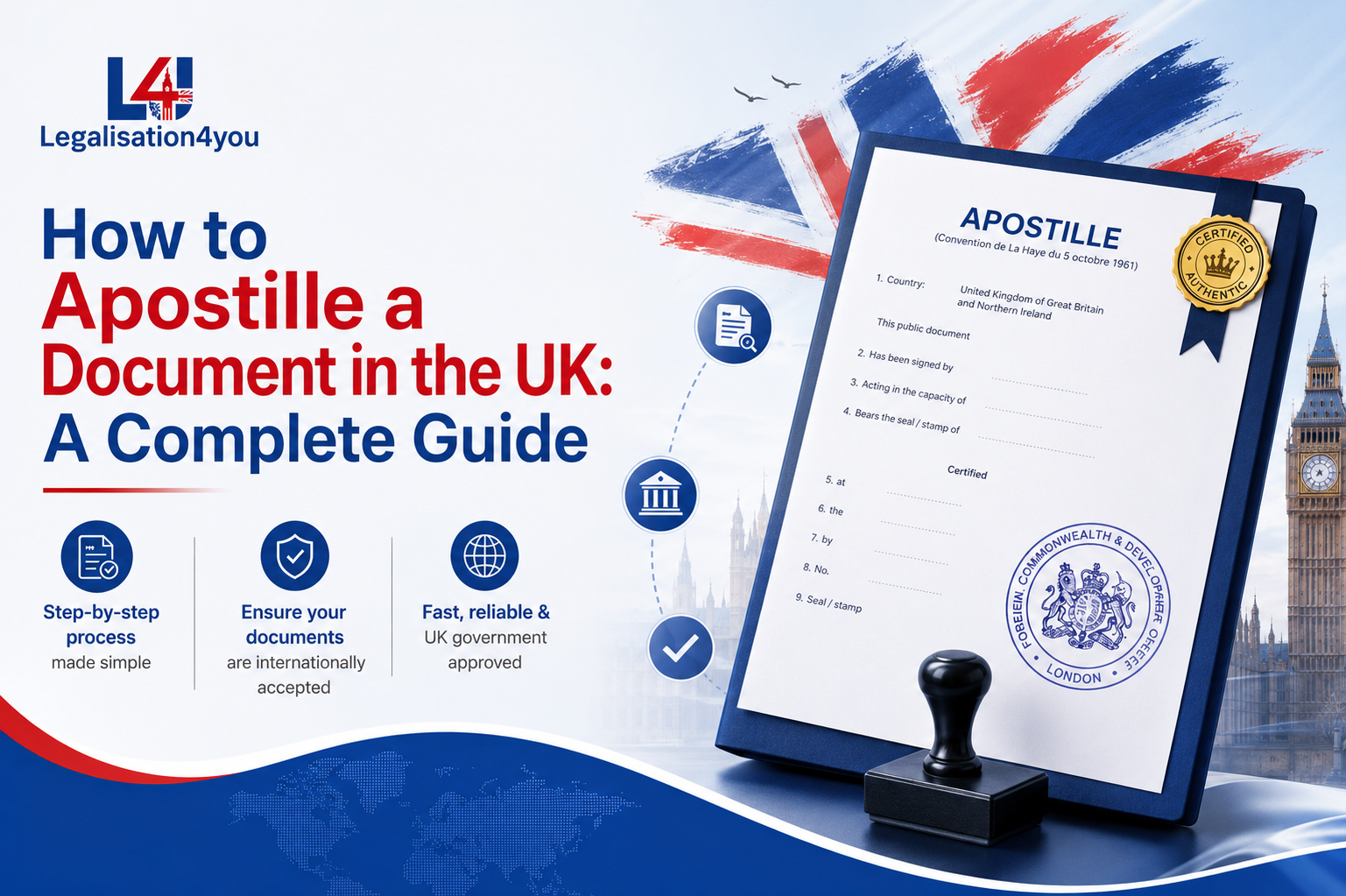
An apostille is an official certificate that proves the signature, stamp or seal on an eligible UK document is genuine, so the document holds up when you use it abroad. The FCDO Legalisation Office issues it. For a lot of UK documents for international use, you won’t get far without one. There are four steps to the whole thing, roughly speaking, and doing them in the right order makes the apostille UK process far less painful than most people expect.
Did you know? The Hague apostille simplifies the process of legalising documents for international use. So if your paperwork is heading overseas, work out early on whether apostille certification actually applies to you. A UK document can usually be apostilled as long as it ticks the FCDO’s boxes: an eligible signature, stamp or seal from a recognised UK public official, or proper certification by a notary or solicitor.
Ever found yourself googling how to apostille a document three days before a deadline, hunting for a paper-based apostille? You’re not the only one. Plenty of UK residents suddenly need an apostille for documents used overseas: a job offer, a wedding abroad, a place at an international university, or some bit of legal paperwork that has to be signed off before anything else can move.
Once you understand how to apostille a document, the whole thing gets a lot simpler, and you sidestep the delays that catch people out when they’re still trying to work out whether they need an apostille at all.
We get asked about this constantly at Legalisation4You. And honestly? Document legalisation is nowhere near as awful as it looks on paper, once you know what happens next.
Key Takeaways
- An apostille authenticates the relevant signature, stamp or seal on an eligible UK document so it can be used abroad.
- Before you apply for legalisation, check whether notarisation or solicitor certification is needed first. Different documents come with different requirements.
- UK apostille requests go through the FCDO Legalisation Office. You can also hand the job to an apostille service and let them run it for you.
- Sometimes you’ll need a translation apostille too, depending on the destination country and whoever is receiving the document.
- Getting professional help cuts the odds of delays or rejected documents, which matters a great deal when there’s an urgent visa, a job or a wedding date riding on it.
What Does It Actually Mean to Get a Document Apostilled?
An apostille is a small official certificate attached to your document. Or, if you’re going down the e-Apostille route, it’s issued electronically instead.
The FCDO Legalisation Office checks the relevant signature, stamp or seal against its own records. Match confirmed? Then the document can be legalised with an apostille.
After that, authorities in countries where the Hague Apostille Convention applies can generally accept the document as it stands, without dragging it through the old chain of diplomatic legalisation.
Understanding Legal Document Authentication
Legal document authentication is just the umbrella term for all of this. Boiled down, it means confirming that the signature, seal or stamp on a document is real before that document gets used overseas.
It comes up a lot with court papers, adoption documents and company records. Legal document authentication is essential for obtaining an apostille certificate. Some documents can go straight through for an apostille. Others have to be certified by a UK solicitor or notary first, before the FCDO will touch them.
Get that order wrong and you’re looking at delays, so check what’s required before you send the apostille document off anywhere.
When Do You Actually Need Legalisation Documents?
You need legalisation documents at the point a foreign authority asks you to prove your UK paperwork has been properly authenticated.
Usually that means official, government-issued or properly certified documents. Not the photocopy sitting in your kitchen drawer.
Common Documents That Usually Need an Apostille
- Birth certificates
- Marriage and death certificates are commonly processed for legalisation and apostille to ensure the…
- University degrees and academic transcripts
- Power of attorney documents
- Company incorporation certificates
- Police clearance certificates and other eligible police documents
Every apostilled document can be treated slightly differently.
Documents issued by a UK public registry (eligible birth, marriage and death certificates, for instance) can normally go straight in for legalisation. Others won’t. Certain powers of attorney, contracts, qualification certificates or document copies often need certification by a UK solicitor or notary before anything else happens.
Check first. Guessing here rarely ends well.

Steps to Getting Your Document Apostilled
Follow the right order and you’ll dodge most of the classic headaches that come with the legalisation and apostille process.
Step 1: Check If You Need Legalisation First
Start by confirming two things: that your document can be legalised at all, and whether it needs certifying before an apostille can be issued.
Some documents require solicitor certification or certification from a UK notary before the FCDO will accept them.
Plenty of other official UK documents can be legalised directly, no middle step needed.
Sort this bit out early. It saves an enormous amount of time later on.
Step 2: Prepare and Certify Your Document
Get hold of the correct original document, or the certified copy the receiving authority has asked for.
If notarisation or solicitor certification applies to your document, arrange it before you submit anything for an apostille.
This stage matters more than people realise, because the FCDO advises applicants to check whether the receiving authority wants the original document, a certified copy, or something signed by a particular type of public official.
Step 3: Submit to the Foreign Commonwealth Office Apostille Service
The Foreign Commonwealth Office apostille service now sits with the Foreign, Commonwealth & Development Office (FCDO) Legalisation Office.
Applications for both paper-based apostilles and e-Apostilles are made online.
With a paper-based apostille you’ll usually post your documents in after applying. Registered businesses can also get at certain additional FCDO services.
Step 4: Wait for Processing and Collect Your Document
How long you wait depends entirely on which type of apostille service you’ve used.
In most cases the standard FCDO paper-based apostille service currently takes up to 25 working days, and that’s before you add courier or postage time on top.
Eligible e-Apostilles can currently take up to 2 working days.
There’s also a next-day paper service from the FCDO, plus a restricted urgent same-day service for registered businesses. If you need things moving faster, a specialist apostille provider with access to the appropriate service is worth a look.
Do You Need a Translation Apostille?
Not always, no.
If your document is going to a country where English isn’t the main language, the receiving authority might ask for a translated version. Might. A translation isn’t automatically required just because they speak another language over there.
Where a translation apostille does come into play is when the receiving authority wants the translated document itself certified or legalised.
Even if you’re using a next-day apostille service for UK documents for international use, check the translation requirements first. It’s a small step that saves a repeat trip.
When Translated Documents Need Extra Certification
Some countries, and some receiving authorities, want the translation certified separately from the original.
Depending on what they ask for, you might need:
- The original apostilled document
- A certified translation
- Certification of the translator’s signature
- A separate apostille for the certified translation
Always check the receiving authority’s exact requirements before you send any document off for use abroad. What’s needed shifts depending on the country, the document and the purpose, particularly where the Hague Apostille Convention and FCDO legalisation are concerned.
Comparing Apostille Service Options
| Service Type | Processing Time | Typical Cost | Best For |
| Standard FCDO legalisation – paper-based apostille | Usually up to 25 working days, plus return delivery | £45 per document, plus courier or postage | Non-urgent applications |
| FCDO e-Apostille | Up to 2 working days | £35 per document | Eligible electronically signed documents |
| FCDO Next-Day Service | Next working day | £40 per document | Registered businesses only |
| FCDO Restricted Urgent Service | Same day, subject to pre-approval | £100 per document | Registered businesses requiring urgent processing |
| Specialist Agency | Varies depending on the document and service | Varies | Complex, urgent or bulk documents |
Premium and same-day services can be a lifesaver when a visa or job deadline is breathing down your neck. Availability isn’t guaranteed though: it depends on the service being used and whether the provider is eligible to access the FCDO’s faster routes in the first place.
A specialist agency dealing with documents used overseas, whether that’s for a job, a marriage abroad, international study or legal paperwork, can also sort out solicitor certification and point you towards the right document legalisation service.
Common Mistakes to Avoid
- Sending an ordinary photocopy when the original or a certified copy is what’s needed
- Skipping the notarisation or certification step on private paperwork where it’s actually required
- Assuming every country or receiving authority wants the same thing for public document legalisation
- Missing a translation requirement altogether
- Applying for an e-Apostille when the document simply isn’t eligible
- Leaving the whole document legalisation process until the very last minute
Pro tip: confirm exactly what the receiving authority expects before you post anything to the Legalisation Office. Requirements vary quite a bit depending on the destination and the type of document, and getting it wrong usually means doing part of the process all over again.
Why Getting It Right the First Time Matters
Rejected or badly prepared applications can often be traced back to the same handful of causes: missing certification, the wrong document type, or requirements from the receiving authority that were never met.
Two minutes of double-checking before submission saves a lot of back-and-forth afterwards.
And the cost isn’t only financial. A rejected apostille can hold up a visa, stall a job application, or push a wedding abroad back by weeks.
For such a small certificate, it carries a surprising amount of weight.
Get Your Documents Apostilled Without the Hassle!
Whether you’re after a fast turnaround or just want someone to make sense of the trickier UK apostille service requirements, expert guidance on apostille legalisation takes the guesswork out of it.
Legalisation4You specialises in apostille and legalisation services, and we’ll tell you what your documents need before they go anywhere near submission.
Paper-based apostille, solicitor certification or an electronic apostille, our team can walk you through it.
Visit our website and get started today with your apostille and document needs.
FAQs
1. How long does it take to apostille a document in the UK?
The standard FCDO paper-based apostille service usually takes up to 25 working days at the moment, plus courier or postage time on top of that.
An eligible e-Apostille can take up to 2 working days.
The FCDO also runs a next-day paper service for registered businesses, along with a restricted urgent same-day service for registered businesses where the application has already been pre-approved.
2. Can I apostille a document myself, or do I need an agency?
You can absolutely apply yourself, directly through the FCDO Legalisation Office.
That said, a lot of people still go through agencies for the convenience, the document checking, and access to faster services where they’re available, especially when a next-day apostille service is the only thing that’ll hit the deadline.
3. Do all countries accept UK apostilles?
No.
UK apostilles are meant for use where the Hague Convention applies between the UK and the destination in question.
Where the Hague Apostille Convention doesn’t apply, your document may need different or additional embassy legalisation steps instead.
Check what the authority receiving the document actually requires. Every time.
4. What is the difference between legalisation and an apostille?
In the UK, legalisation is the process where the FCDO Legalisation Office checks the relevant signature, stamp or seal on an eligible document and attaches an apostille to it.
If the Hague Apostille Convention doesn’t apply, you may also need further legalisation through an embassy or another authority.
5. Does a translated document need its own apostille?
Not necessarily.
Whether a translation needs separate certification, or an apostille of its own, comes down to the receiving authority’s requirements.
A translation apostille may be required where the certified translated document itself has to be legalised. In other cases the authority is happy with the original apostilled document plus a certified translation alongside it.