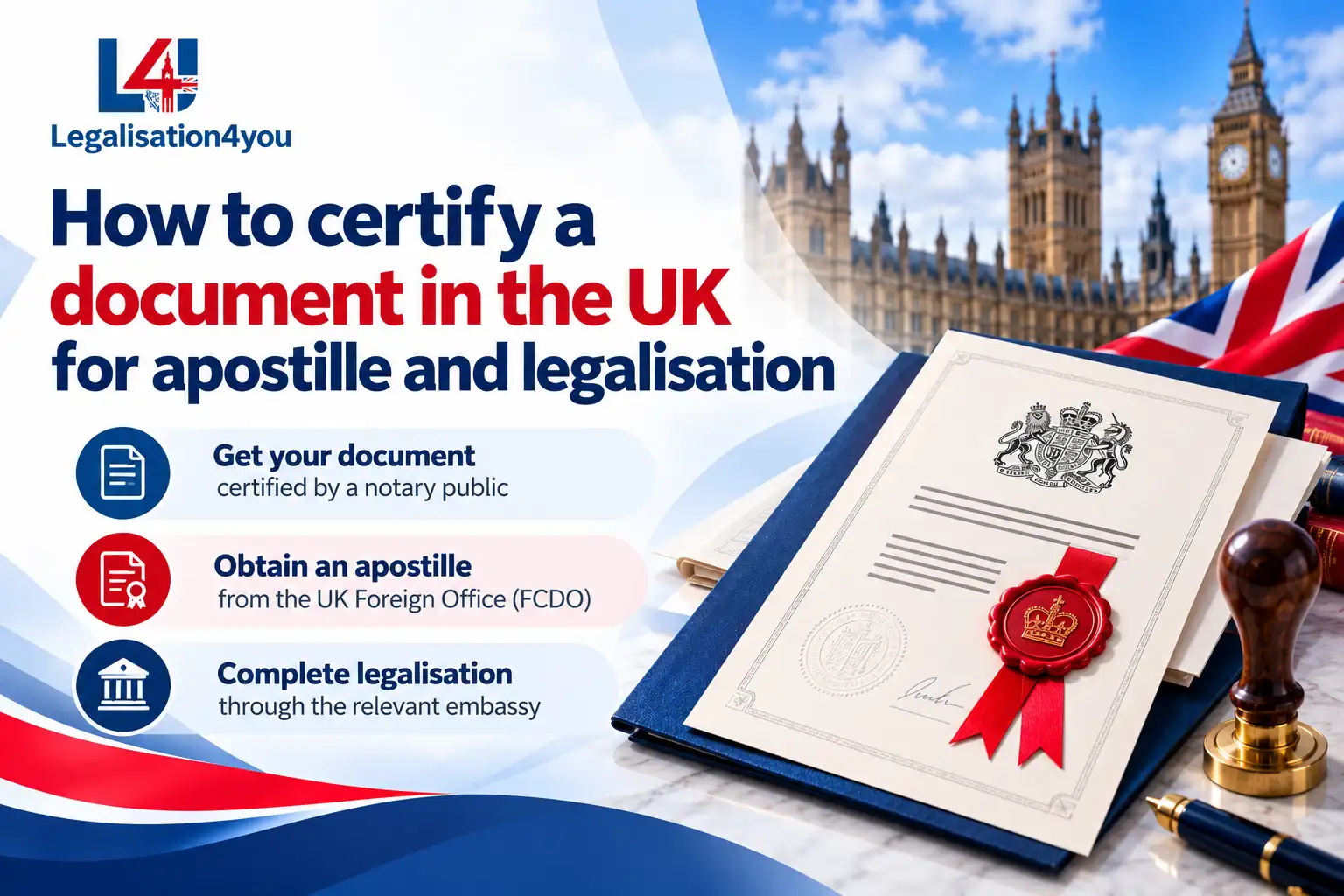
Book a regulated solicitor or notary public to certify your document in the UK. They check the original, sign a true copy, and add their details. Then you can apply for an apostille. Want to avoid costly rejections? Keep reading.
Did you know? According to the Hague Convention, the Legalisation Office can legalise many documents, including birth certificates, marriage certificates, degree certificates, and company documents.
But a UK public official, such as a notary or solicitor, must certify them first. Plenty of people miss that rule. Then their paperwork bounces back. This guide shows how to certify a document UK officials will accept. Legalisation4You helps people with this every week, so we know where things go wrong. Let’s fix that for you.
Key Takeaways
- Only a regulated UK solicitor or notary public can certify your document for legalisation purposes.
- Certification comes first, then the apostille follows, so never reverse the order of these steps.
- Many government-issued originals skip certification and go straight to the apostille stage, saving you time.
- Non-Hague countries may demand extra document attestation at their embassy after you receive your apostille.
- Check the destination country’s rules early, because one overlooked detail can trigger a costly rejection.
Certifying a Document in the UK: What It Really Means
When we talk about certifying documents, we mean one simple thing. A trusted professional confirms your copy matches the original. They sign it, date it, and add their contact details. Overseas offices then trust your copy.
Don’t mix this up with an apostille. That comes later. The FCDO Legalisation Office adds it to confirm that the signature, seal or stamp is genuine. It never checks what the document actually says. Picture two locks on one door. Certification is the first lock. The apostille is the second.
Certified True Copy vs Apostille Certificate
- A certified true copy proves your copy matches the original.
- An apostille proves the official signature is real.
- Hague Convention countries accept the apostille alone.
- Other countries often want more.
Who Can Certify a Document in the UK?
So, who can certify a document UK authorities will accept? The list is short. Only a UK public official counts:
- Solicitors who are regulated in the UK
- Notaries public, who handle many legal papers
Your friend, teacher or doctor can’t do it. The FCDO may reject their stamp. That one slip wastes time and money.
Why Choose a Solicitor to Certify Documents
For passport copies, ID, degrees and transcripts, use a solicitor to certify documents. They usually cost less than notaries. They’re quick, too.
Your solicitor must see the original. Then they sign a statement saying your copy is true. GOV.UK lists official directories, so finding a regulated professional is easy.
When a Notary Public Is the Better Choice
Legal papers often need a notary first. Think powers of attorney, affidavits and statutory declarations. A notary also adds weight to business papers headed overseas.
Step-by-Step Guide to Certify Your Document for Apostille
Take these steps in order. Each one protects your application.
- Check the destination. Ask the overseas body what it wants. Rules change from country to country.
- Spot your document type. Some originals skip certification. Copies and academic papers usually need it.
- Gather your originals. Bring clear copies as well. Many solicitors ask for photo ID too.
- Book your professional. Pick a regulated solicitor or notary.
- Read the wording. Check the name, date, signature and contact details.
- Apply for the apostille. Use the official GOV.UK legalisation service.
- Plan the embassy step. Some countries need extra document attestation.
What a Certified Copy Should Include
Your solicitor should add these items:
- A statement that the copy matches the original they saw
- Their signature and the date
- Their full name and firm
- Their address and contact details
Pro tip: Never write on the copy after certification. Even a tiny mark can cause trouble.
Which Certification Route Suits Your Document?
| Document | Certify first? | Who certifies |
| Original birth, marriage or death certificate | Usually no | Nobody needed |
| Passport or ID copy | Yes | Solicitor or notary |
| Degree certificate or transcript | Often | Solicitor or notary |
| Power of attorney or affidavit | Yes | Notary public |
| Certificate of incorporation | Usually no | Nobody needed |
Rules vary by format and destination. Always confirm before you apply.
Apostille or Document Attestation: What Comes Next?
Hague Convention countries accept the apostille alone. Your journey ends there.
Embassy Legalisation for Non-Hague Countries
Other countries ask for more. After the apostille, you may need document attestation at the embassy. The UAE, Qatar and Egypt often want this step. Timings differ by embassy, so plan early.
E-Apostille Option for Digital Documents
There’s also the e-Apostille. GOV.UK says you upload a PDF that a UK notary or solicitor signed electronically. Not every document qualifies, so check first.
How Long Does It Take to Certify a Document in the UK?
Certification is quick. Many solicitors finish it in one visit. The apostille takes longer, so allow extra days. GOV.UK offers a same-day service, but only registered businesses can use it. Book early if you can.
Certified Translation for Foreign-Language Papers
Some documents need a certified translation. Ask the receiving body before you start. Arrange it early so your whole set travels together. That small step spares you last-minute panic.
Common Mistakes When Certifying Documents
One small slip can cost you weeks of stress. Watch out for these:
- Certifying a copy of a copy
- Using someone who isn’t a regulated solicitor or notary
- Leaving out the date or signature
- Ignoring the destination country’s rules
- Submitting a document issued outside the UK
GOV.UK also warns that you get no refund if your document can’t be legalised. A careful check now protects your money later.
Certify Your Documents Without Stress!
Now you know how to certify a document in the UK. Don’t gamble with your deadline. Get your paperwork right the first time. The expert team at Legalisation4You confirms the correct route before any work begins. Contact them today and move your documents forward with confidence.
FAQs
1. Who can certify a document in the UK?
A regulated UK solicitor or notary public can certify your document. Friends, teachers and doctors don’t count for apostille purposes, so choose a recognised professional.
2. How do I get a document certified in the UK?
Book a solicitor or notary. Take your original and photo ID. They check the document, sign a true copy, and add their contact details.
3. Can a solicitor certify a copy of my passport?
Yes. A solicitor can certify a passport copy after seeing the original. They sign and date it, then add their details.
4. Do all documents need certification before an apostille?
No. Many government-issued originals go straight to the apostille. Copies, academic papers and signed legal documents usually need certification first.
5. What is document attestation?
Document attestation is an embassy step after the apostille. Countries outside the Hague Convention often require it before they accept your UK document.