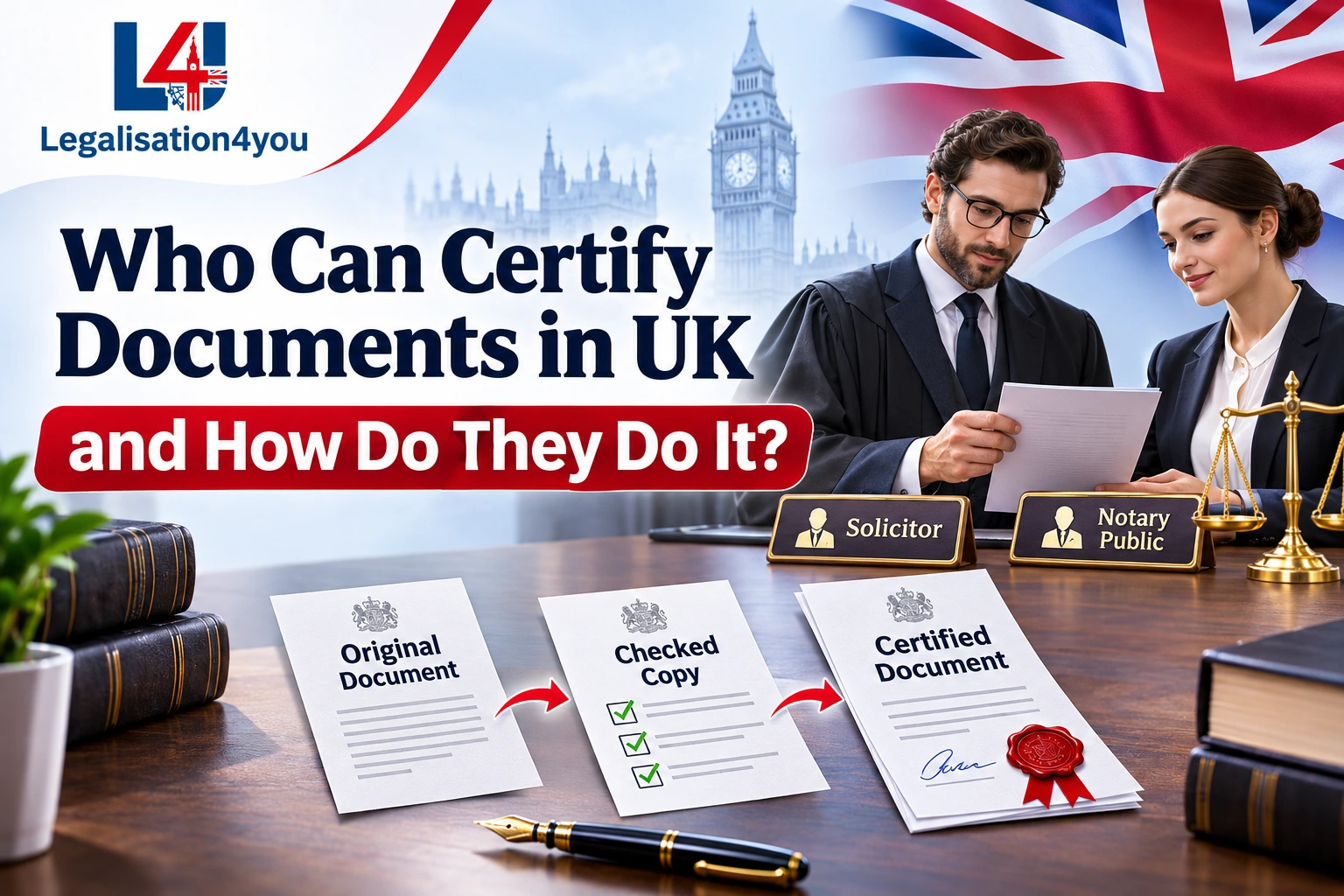
Solicitors and notaries public can certify documents in the UK. They check your original, compare the copy, then sign and stamp it. For overseas use, you may need an apostille too. Read on to avoid costly delays and sudden rejections.
Did you know? According to the Federal Apostille and Notary Processing, the Hague Apostille Convention now covers about 130 countries.
Yet many people still wonder who can certify documents in UK offices before they apply. At Legalisation4You, we see this confusion every week. One wrong signature can stall a visa, a job offer or a house move.
Key Takeaways
- Pick the right certifier. Solicitors and notaries public certify UK documents, so choose the one your receiving body accepts.
- Certification checks the copy. A certifier compares the copy with the original, then signs, dates and stamps every page.
- An apostille proves authenticity. The FCDO issues an apostille confirming a UK official’s signature or seal is genuine abroad.
- Know your route. Private papers usually need a notary first, while government records go straight to the FCDO.
- Plan for fees and translation. Check current fees on GOV.UK. Order translation after the apostille when your destination requires it.
Who Is Allowed to Certify Documents in the UK?
Certification means a trusted person confirms your copy matches the original. It does not prove the content is true. It proves the copy is faithful. Banks, universities, landlords and embassies often ask for it. Each body sets its own rules, so always ask first.
Solicitors and Legal Professionals Who Certify Copies
Solicitors are the most popular choice and hold regulated status. GOV.UK confirms the Legalisation Office accepts documents certified by a UK public official, such as a solicitor or notary. Most solicitors check your ID, view the original and sign the copy. If you cannot visit a high street firm, you can book solicitor certification online.
Notaries Public and Notarial Certification
Notaries public carry extra international weight. They certify copies, witness signatures and notarise company papers. Private papers, such as powers of attorney, usually need a notary first. Our notary services page explains the details.
Other Professionals Who May Certify Copies
Some bodies accept copies certified by accountants, bank officials, teachers or doctors. However, these routes rarely work for an apostille. The FCDO expects a solicitor or notary. Check the receiving organisation’s wording before you book anyone.
| Certifier | Best for | Accepted for apostille? |
| Solicitor | Copies of passports, degrees and certificates | Yes |
| Notary public | Powers of attorney, company papers and affidavits | Yes |
| Accountant, bank official or teacher | Some UK banks, employers and schools | Rarely |
How Do Certifiers Check and Certify Your Documents?
Expect these steps:
- Bring the original. The certifier must see it, not just a scan.
- Show your ID. A passport or driving licence usually works.
- Compare the copy. They check every page against the original.
- Add the wording. Most write “certified true copy of the original seen by me”.
- Sign, date and stamp. They add their name, firm and contact details.
Never photocopy the certified page afterwards. A copy of a copy loses its value.
Common Certification Mistakes to Avoid
Avoid these slips:
- Certifying a copy of a copy
- Missing the date, signature, or printed name
- Choosing a certifier the receiving body does not accept
Pro tip: Ask the receiving body for its exact wording before your appointment.
Who Needs an Apostille After Certification?
Apostille Meaning and Hague Convention Basics
Many readers ask what is apostille and why it matters. An apostille is an official certificate. It confirms the signature, seal, or stamp on a UK public document is genuine. The FCDO issues it under the Hague Convention. One apostille then works across member countries.
How to Get a UK Apostille Step by Step
Next, many applicants ask how do you get a document apostille from the FCDO. The process is simple:
- Check eligibility. Government records often qualify directly. Private papers need a solicitor or notary first.
- Apply online. Use the GOV.UK legalisation service.
- Pay the fee. GOV.UK lists £45 per document for the standard paper service, plus postage.
- Send your document. You receive the postal address after applying.
- Receive your apostille. The FCDO attaches it and returns the document.
GOV.UK says birth, death and marriage certificates cannot get an e-Apostille. The FCDO refunds your fee if it cannot legalise a document, but not if the recipient rejects it. Fees change, so check GOV.UK first.
Apostille Translation for Foreign Authorities
Some countries also need apostille translation before they accept your papers. A professional translator renders the document and apostille into the required language. They sign a statement confirming accuracy. Most authorities expect translation after the apostille is attached, so confirm this first. Our certified translation team can help.
Apostille or Notary: Which Route Fits Your Document?
People often debate apostille or notary before a move abroad. The two do different jobs. A notary verifies and certifies your document. An apostille proves a UK official’s seal is genuine. You often need both, in that order.
| Feature | Notary | Apostille |
| Provided by | Notary public | FCDO Legalisation Office |
| Main job | Verifies and certifies the document | Confirms the seal or signature is genuine |
| Best for | Private papers, such as powers of attorney | Public or notarised papers going abroad |
| Order | First step | Second step |
Birth, marriage and death certificates usually skip the notary. Business papers and affidavits usually need one first.
Why Proper Certification Saves Time and Money
A correct start protects your budget and deadline:
- Fewer rejections. Receiving bodies accept properly certified files the first time.
- Lower costs. You pay for each step once. Rejected documents mean new fees and new postage.
- Faster decisions. Visa teams, universities and employers process clean files quickly.
- Peace of mind. You know every stamp, signature and seal meets the rules.

Make Document Legalisation Simple With Legalisation4You!
Now you know who can certify documents in the UK. Rules feel tricky, but you do not need to guess. Legalisation4You checks your route before processing, so you avoid wasted fees. Our FCDO-registered team handles certification, notarisation, apostille and translation in one place. Request your free quote today and send your papers abroad with confidence.
FAQs
1. Who can certify a document in the UK?
Solicitors and notaries can certify documents. Some banks and employers also accept accountants, doctors or teachers. Always check the receiving body’s rules first.
2. Can I certify my own documents?
No. An independent, qualified person must check your original. Most organisations also reject certification by relatives or close friends.
3. How much does it cost to certify a document in the UK?
Fees vary by firm and document type. Solicitors often charge less than notaries. The FCDO adds its own apostille fee on top.
4. What is the difference between a notary and an apostille?
A notary certifies your document. An apostille confirms the official seal on it is genuine. Many overseas users need both.
5. Which documents can get a UK apostille?
Official UK documents qualify, such as birth, marriage and death certificates, court papers and notarised files. Documents issued outside the UK do not qualify.