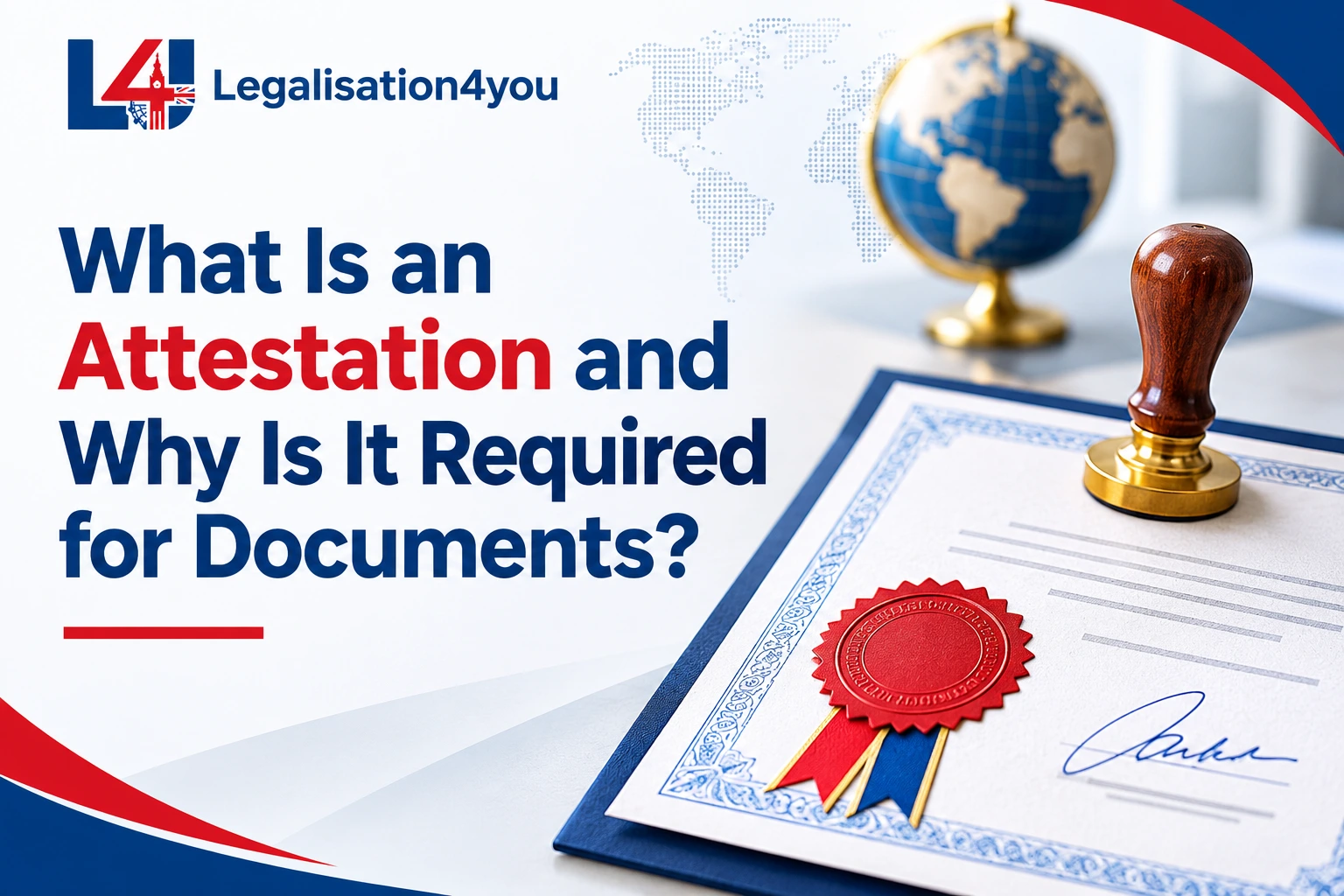
Attestation is an official check that proves your paperwork is genuine. A trusted person confirms the signature, seal, or copy. Foreign offices then accept the file without any doubt. Skip this step, and your whole application may stall for weeks.
Did you know? Gov.uk says British embassies, high commissions and consulates can’t legalise any document.
Ever wondered what is an attestation and why every office keeps asking for one? At Legalisation4You, we hear that question daily. So in this blog, we will understand what an attestation is and why it is required for documents.
Key Takeaways
- Attestation confirms a signature, seal or copy is genuine, so overseas offices can trust it.
- Foreign offices demand it to block fraud, since they cannot easily check UK papers themselves.
- Solicitors, notaries, the FCDO and embassies each handle one link in the full attestation chain.
- Copies need certifying first, while many UK-issued originals can go straight for an apostille stamp.
- Always check your destination’s rules first, because one wrong step costs you time and money.
Understanding Attestation and What It Really Means
So what is an attestation? A person with authority confirms a fact about your document. Maybe it’s a signature. Maybe it’s a stamp. Or maybe it’s proof that a copy matches the original.
Think of it as a trust badge. Someone overseas can’t check your UK paperwork. So an official vouches for it first. It’s like a handshake between two countries.
Every attestation of documents follows one idea. A reliable person checks the paper. Then they add a signature, seal, or stamp. That mark tells the reader it’s real.
Attestation vs Notarisation vs Legalisation
These terms get mixed up a lot. Attestation is the broad idea of confirming a document. Notarisation is one form, done by a notary public. An apostille is another, issued by the FCDO. Legalisation is the whole chain, from certification to the final stamp. They differ, yet they connect.
Why Overseas Offices Insist on Attested Papers
Fraud worries foreign officials. They see thousands of papers each year. They can’t ring a UK registry for every one. Attestation fixes that. Solid document attestation also saves you from costly rejection.
Picture a nurse moving abroad. Her degree certificate needs checking before the hospital hires her. Without attestation, the hospital can’t trust the paper. With it, approval moves much faster.
You’ll usually need it for:
- Visa and immigration applications
- Overseas jobs and work permits
- University admissions abroad
- Marriage registration abroad
- Company setup and trade deals
- Property and legal matters
Every office sets its own rules. So ask the requesting body first.
Who Attests Documents in the UK?
Solicitors and notaries certify copies and signatures. The FCDO issues the apostille. Embassies add the last stamp when needed. Each one checks only its own part.
Documents That Often Need Attested Copies
Here’s what comes up most:
- Birth, marriage and death certificates
- Degree certificates and transcripts
- Police and DBS certificates
- Powers of attorney and affidavits
- Company records and board resolutions
- Passport and ID copies
UK-issued originals, such as birth certificates, can often go straight for an apostille. Copies usually need certification by a solicitor or notary first.
The Main Steps in the Attestation Process
Most files follow a clear path. The table below shows each stage.
| Stage | Who does it | What it proves | Common use |
| Certification | Solicitor or notary | The copy matches the original | Passport and ID copies |
| Notarisation | Notary public | The signature and identity are genuine | Powers of attorney |
| Apostille | FCDO Legalisation Office | The official’s seal is real | Hague Convention countries |
| Embassy attestation | Destination embassy | The apostille is accepted locally | Countries that ask for it |
Certified True Copy: Simple Steps
Wondering how to certify a copy of your passport? Here’s the route:
- Take your original and a clear photocopy to a solicitor or notary.
- They compare the copy with the original.
- They sign, date, and stamp the copy as a true copy.
- Send it for an apostille if your destination needs one.
GOV.UK confirms that a UK public official, such as a notary or solicitor, must certify these copies. Our solicitor certification starts from £20.
Apostille and Embassy Attestation Explained
The FCDO Legalisation Office issues every apostille stamp that England documents carry. It confirms the official’s signature or seal is genuine.
Our standard apostille starts from £85 and takes three working days. Express starts from £95 for the next working day. Order early if your deadline is tight.
Not every file qualifies for an e-Apostille. GOV.UK rules out e-Apostilles for General Register Office certificates.
Embassy Attestation for Other Destinations
Some countries want one more step. After the apostille, the destination embassy in London adds its own stamp. GOV.UK calls this a three-step process for countries outside the Hague Convention.
Timing matters too. Embassy steps add extra days, so plan for tight deadlines.
We support more than 15 embassy destinations. We confirm the exact rules before any work begins.
Common Mistakes That Delay Your Attestation
Small errors cause big delays. Watch out for these:
- Sending a photocopy without any certification
- Skipping the notary for a power of attorney
- Picking an e-Apostille when the office wants paper
- Guessing the route for your destination
A wrong step costs time and money. GOV.UK warns that fees stay unrefunded when a recipient rejects a legalised document. Gather your original, a clear copy, and your destination details before you start. That small bit of prep saves days.
Don’t let one missing stamp ruin your big move. Avoid stress, delays, and heartbreaking rejection by choosing the right route from day one.
Get Your Documents Attested With Confidence
Stop guessing and start with a clear plan. Legalisation4You checks your route before any work begins. We’re registered with the UK Legalisation Office for next-day apostilles. Our team handles certification, notary work, apostille, and embassy attestation. Order online today or call us now. Your documents deserve a safe journey.
FAQs
1. What does attestation of a document mean?
It is an official check that confirms a signature, seal, or copy is genuine.
2. What is the difference between attestation and apostille?
An apostille is one type of attestation. The FCDO issues it for use in Hague Convention countries. Other types include solicitor certification and embassy stamps.
3. Who can attest a document in the UK?
Solicitors and notaries certify copies and signatures. The FCDO adds the apostille. Embassies add a stamp when the destination asks.
4. Why is document attestation required?
Foreign authorities cannot check UK papers themselves. Attestation lowers fraud risk and helps your application pass smoothly.
5. How long does attestation take?
It depends on the route. Our standard apostille takes three working days. Express takes one working day. Embassy steps add extra time.