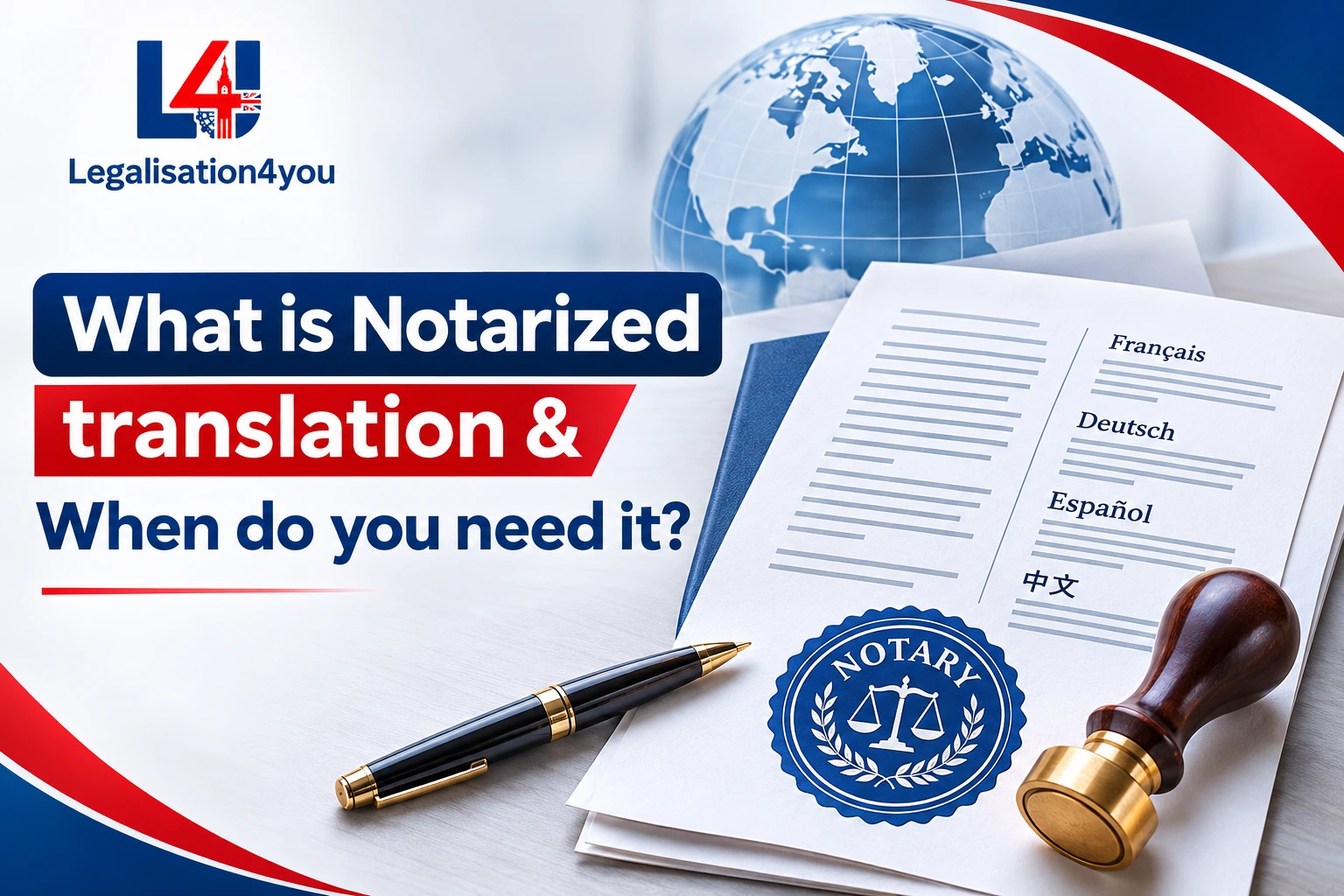
A notarised translation is a certified translation whose translator signs a statement before a notary public. The notary confirms the signer’s identity and adds a stamp. You usually need one for overseas use, court filings, and some official bodies abroad.
Did you know? Gov,uk says if you submit a document that is not in English or Welsh, it must be accompanied by a full translation that can be independently verified by the Home Office.
Many people stop there and miss the next step. At Legalisation4You, we help clients pick the right route every day. A notarised translation adds extra proof that suits many legal and overseas cases. This guide explains it in plain English.
Key Takeaways
- A notary stamp turns a certified file into a notarised translation for overseas use.
- The notary checks identity, not translation quality, so hire a qualified linguist.
- Most visa files need a certified translation for UK visa use, not a notary stamp.
- Overseas courts and registries often want documents for translation stamped by a notary.
- Add an apostille when the destination country belongs to the Hague Convention.
What Does a Notary-Verified Translation Mean?
A translator first completes the full translation. Then the translator signs a declaration of accuracy in front of a notary public. The notary checks the signer’s photo ID and adds an official stamp and signature.
This process proves who signed the statement. It does not prove the translation is perfect. The notary does not check both languages. The translator’s skill still matters most, so choose a qualified linguist.
Certified vs Notarised: The Key Differences
Both options start with a signed statement. The notary stage is the main difference.
| Feature | Certified Translation | Notarised Translation |
| Translator’s signed accuracy statement | Yes | Yes |
| Signed before a notary public | No | Yes |
| Notary stamp and seal | No | Yes |
| Typical use | Visas, universities, banks | Overseas bodies, courts, property |
| Apostille possible | No, unless notarised first | Yes, via the notary’s signature |
| Cost and speed | Lower, faster | Higher, slightly slower |
What a Notary Checks and What They Skip
- They check: The signer’s identity and signature.
- They add: An official stamp, seal, and date.
- They skip: The quality of the translation itself.
- They skip: The truth of the original document.

When Do You Need a Notary-Stamped Translation?
Rules differ by country and by office. The receiving body always makes the final call. Ask what it accepts before you pay. You will often need a notary stamp in these cases:
- A foreign court asks for translated evidence.
- An overseas land registry handles your property purchase.
- A foreign embassy or consulate reviews your file.
- A foreign authority wants a power of attorney in its language.
Tip: Ask for the requirement in writing. That one email can save you weeks.
Documents for Translation That Often Need a Notary
Many documents for translation fall into this group. Common examples include:
-
- Marriage and divorce certificates
- Powers of attorney and affidavits
- Company incorporation papers
- Court orders and judgments
Birth Certificate Translation and When a Notary Helps
Clients ask for birth certificate translation more than almost anything else. A certified version works for many UK uses. A foreign registry or consulate may want a notary stamp as well. Check the rules for your destination first.
Visa Applications and Notary-Stamped Translations
Many readers arrive here because of a visa. The news is simple. UK visa rules ask for a certified translation, not a notarised one.
Certified Translation for UK Visa Applications
For a certified translation for UK visa applications, the translator must add a signed accuracy statement. The statement needs the date, the translator’s signature, and their contact details. Partial translations risk a refusal. Always check the latest GOV.UK guidance for your visa type.
How to Translate Notary Papers From Abroad
Sometimes the notary paper itself needs translating. This happens when a foreign notary draws up a deed or declaration. You must translate notary documents in full, including every stamp, seal and handwritten note. Then a qualified translator certifies the result. Ask your provider whether a second notary step is also needed.
How to Arrange a Notary-Backed Translation
- Check the requirements. Ask the receiving body what it accepts.
- Gather your originals. Send clear scans or the paper originals.
- Choose a qualified translator. Look for membership of a respected body such as the CIOL or ITI.
- Sign before a notary. The translator signs the declaration in the notary’s presence.
- Add an apostille if needed. Many Hague Convention countries ask for one.
Apostille After Notarisation
An apostille is an FCDO certificate. It confirms the notary’s signature and seal are genuine. Countries in the Hague Convention accept it. Others may ask for embassy attestation too. Plan early, because each stage adds time.
Common Notary Translation Mistakes to Avoid
- Skipping the requirements check. Rules vary by body.
- Using a friend or relative. Many offices reject self-made translations.
- Translating only part of the file. Partial translations often get refused.
- Forgetting the apostille. Overseas offices may send your file back.

Get Your Notarised Paperwork Right the First Time
Don’t let a rejected file ruin your plans. Legalisation4You arranges certified translation, notary signing and FCDO apostilles in one smooth order. Our London team checks the route before any work begins. You get clear updates and secure, tracked delivery. Call us now or ask an expert today. Act now and get certainty fast.
FAQs
1. What is a notarised translation?
It is a certified translation signed by the translator before a notary public. The notary verifies identity and adds a stamp. It confirms who signed, not translation quality.
2. Is a notarised translation the same as a certified translation?
No. A certified translation carries the translator’s signed statement alone. A notarised one adds a notary’s stamp. Both need a full, accurate translation.
3. Does the Home Office need notarised translations for a visa?
Usually no. GOV.UK asks for a certified translation with a signed accuracy statement, date and contact details. Always check the guidance for your visa type.
4. Who can notarise a translation in the UK?
A qualified notary public handles this. The translator attends, shows a photo ID and signs the declaration.
5. How long does it take?
Certified translations often take one to two working days. Notarisation adds a little time. Apostilles and embassy steps add more, so plan ahead.